The Shocking Truths About High Frequency Trading
In this letter, Ivan Lo reveals the Shocking Truths About High Frequency Trading, how it affects our markets, how and why it works, and the dangers involved
by Equedia12 minute read
“There is no such thing as bug free software. If you are an investor, learn how to hedge.” – Mark Cuban
The Shocking Truths About High Frequency Trading
Manipulation. Rigging. Computer Traders. High Frequency Trading. Hackers. Your Money.
All of these words fit together in one category: the stock market.
For many years, I have talked about how the stock market really works; how it has and always will be manipulated.
The movies you see — Wall Street, Boiler Room, and Margin Call — are all movies based on events that have happened before, in one form or another. The only difference is instead of big name actors, its big name bankers, traders, and politicians – we are the extras, the victims.
If you think that manipulation in the stock market doesn’t exist, then I urge you to read the rest of this letter; If you already know it does, and even have some real-life experiences you want to share, then follow the link below and make a comment.
Click Here to Comment on High Frequency Trading
I am here to present the facts, but it is up to you to connect the dots. In future letters, I will write up direct examples of manipulation in the stock market.
Manipulation has always been a part of the stock market game. Whether it was insider information, or price action manipulation via large sell or buy orders, it was done in a way that regular investors actually stood a chance because they could see the price action happening and react accordingly.
But technology and the advent of high-frequency computer trading/algorithmic software have changed the way the stock market is now being manipulated.
High Frequency Trading
“The world is literally on the brink of a financial collapse and we have software programs running and gauging our day-to-day markets. It’s a scary thought.
Software programs have bugs. At any given time, the wrong input our output could cause catastrophe. I am sure everyone has had their computer crash or had some kind of weird malfunction with a software program before. Imagine when it happens with software trading programs that control billions of dollars worth of wealth – i.e. flash crashes.
Current data shows that more than 70% of all equity volume traded in the US markets is now as a result of these algo-traders (the SEC cites 50% or more.) In a market where retail investors are holding onto cash, this percentage may be even higher. That means retail investors who have the ability to gauge economic factors are no longer controlling market sentiment; computers do.
If history tells us that the stock market is forward looking by 6 months, then computer programs are now dictating our future.”
The Lack of Patience
Investors are growing more impatient everyday, turning the stock market into a casino, rather than a platform to help companies grow.
According to Business Insider, investors now hold stocks on average for only five days; compare that with the eight years in the 1960s.
If business performance dictates how a stock should react, than companies are now only given five days to succeed. After all, that’s the average time investors are holding stocks now.
But if you think that’s a short time frame, wait until you hear how long the software programs – the same ones that represent nearly 70% of all volume in the U.S. – hold stocks for.
On average, high frequency traders (HFT) hold stocks for no more than 16 seconds:
“Investors have turned into day traders. Day traders have turned into algo-traders, who not only make trades in 10 milliseconds or less, but also typically hold stocks for no more than 16 seconds. The days of watching the ticker tape to get a sense of where a stock is headed is over.” – The Equedia Letter: A Nuclear Threat, Jan. 2013.
Not only are stocks being held for no more than 16 seconds, the software’s decision to buy or sell a stock is made in less than 10 milliseconds. Some say it’s as fast as half a millionth of a second – that’s more than a million times faster than the human brain can process a decision.
That may sound fast, but how fast does it really sound?
The Speed of Sound
The guys over at Nanex track every single market transaction. They provide hundreds of charts that show just how fast the market moves. Their research clearly shows trading speeds that no human will ever experience.
Looking at the charts is one thing, but how about hearing them?
Take a listen to this:
NYPR On-Demand Radio
Play/Pause
Volume
The sounds you hear are the trades made for one stock, within that given time period. A musical note was assigned to every buy or sell order on that stock. The pitch is determined by the price of the order; the higher the pitch, the higher the price.
Those sounds are clearly too fast for us to track.
Here is the same clip, slowed down:
NYPR On-Demand Radio
Play/Pause
Volume
So how can the average trader or technical chart expert make smart bets when they’re competing with a program that can make decisions faster than any human ever could?
These programs are also used to trade stocks up, or down, by giving the optical illusion that a stock is being bought with momentum, or sold with force. It’s essentially rigged market making.
That is why it is so hard for technical traders, and those who follow the ticker tape, to get a grasp of where price action will lead a stock.
Why the Need for Speed?
Arbitrage. By selling stocks practically as soon as they buy them, the high-frequency traders can manipulate small price differences in the stock market.
Faster trades equal more money. That is why the algorithms and the technology used in HFT are always being upgraded to work faster.
In HFT, it doesn’t matter how much money is moving in each direction per trade, it’s the amount of trades the program can make in a split second that’s important.
Think of it this way:
If I can make 10,000 trades every second and arbitrage $0.0001 cents per trade, that equals to $1 every second, $60 every minute, and $3,600 in just one hour.
What may seem like worthless fractions of a dollar, soon becomes much more. Because of this arbitrage advantage in speed, HFT algorithms are continually being upgraded to analyze both short and long-term trends, as well as tiny momentary blips in trading.
But over the years, their analyses have been upgraded to include news and sentiment using many different forms by scanning buzzwords from sources such as Google trends, and even twitter feeds.
The Dangers of High Frequency Trading
Late April, I tweeted how the Associated Press’ Twitter account was hacked:
False #Rumor of #Explosion at #WhiteHouse. AP Confirms Its #Twitter Feed Was #Hacked. What’s next? Hack the stock market? Oh, wait…
— The Equedia Letter (@equedia) April 23, 2013
One simple hacked Tweet, sent via The Associated Press’ (AP) Twitter account, was enough to bring down Wall Street for nearly 10 minutes on April 23. Here is the fake tweet sent via AP’s Twitter account:

Within seconds, the Dow fell 143 points as a result. So were fear-induced investors the reason for the sell-off? Could investors have possibly reacted so quick to the Tweet? Did everyone have their Twitter accounts open at the same time, just as the hacked Tweet was sent?
Not according to AP:
“Tuesday’s plunge wasn’t really due to a bunch of anxiety-ridden, eager-to-sell human investors. It was largely the fault of supercomputers pre-programmed to buy and sell stock automatically based on, among other things, buzzwords they find in news items.”
The Syrian Electronic Army
A group claiming to support Syrian President Bashar al-Assad took responsibility for the attacks, tweeting:
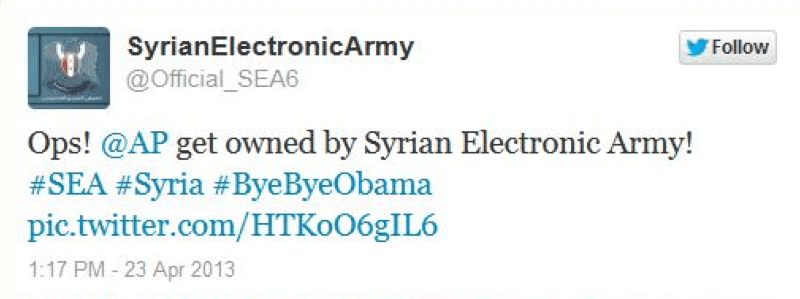
The Syrian Electronic Army also claim to have been behind similar attacks on the twitter feeds of Agence France Presse news agency, Sky News Arabia, Al-Jazeera mobile and CBS News.
The question is not how, but why?
Was it merely computer hacktivists making a statement? Or was it a calculated plan of attack to make millions, perhaps billions, shorting the markets to fund a global war?
The Financial Electronic War
I talked about the financial war before; how major battles are no longer fought with just guns and ammunition, but rather currency and information technology,
The scary part is that it doesn’t take thousands of men to fight, or win, these wars. All it takes is a few smart hackers and computer geniuses to take down the world’s biggest financial systems and send an economy to its knees.
So while banks and other financial systems, as well as government organizations such as the Pentagon, have dedicated security teams and apparently enough power to fight hackers, other portals may not.
The financial world, via high frequency trading software and other platforms, is now so intertwined with social media and other online accounts that hacking basic social media accounts and feeds could easily cause a major financial disaster.
So while the Pentagon or Wall Street may have enough (that’s a BIG “may”) security to prevent a hack from occurring, does Twitter have the same type of security in place? Especially when many of these passwords are easily hacked by a 10-year old computer whiz?
SEC Powerless
Via Huffington Post, April 2012:
“The Securities and Exchange Commission does not currently have the ability to fully monitor what, by most accounts, makes up a majority of the stock trading activity in the United States, according to former SEC lawyers.
…The SEC does not publicly offer its own estimate of the percentage of the overall equity market that high-frequency trading accounts for. But in congressional testimony in 2010, SEC Chair Mary Schapiro said, “By any measure, \
…The commission doesn’t have the ability to monitor high-frequency trading, not just in terms of sophistication; it doesn’t have the cold hardware to keep up,” said Khinda, now co-head of the SEC enforcement practice at Steptoe & Johnson in Washington. “It doesn’t have the tools. It’s only just begun to assemble them.”
It’s clear that HFT cannot be policed. There simply aren’t in enough resources to fight the battle against these supercomputers. When you consider that these computers control billions of dollars in trade, without regulation, that’s a scary thought.
But security and regulation isn’t the only thing you need to worry about.
Battle of the Machines
One of the things that you rarely hear about is the competition between many of these software-trading platforms.
Not only are these supercomputers programmed to analyze market feeds and trading patterns, they are also programmed to sabotage each other by creating false price action and fake market orders; in other words, pure manipulation.
These computers not only make trades in milliseconds, but they also fake them in milliseconds.
Trade orders are often sent and cancelled just to throw a kink into competing programs. Many of the trades are made just to flood the market and trick other computers (or investors) into thinking that a trend may be occurring in a particular stock, when no trend really exists.
Consider the facts
HFT’s are programmed to read feeds and analyze data, but they can’t verify if the data is true or false. This was clearly evident in the AP Twitter hack scenario.
And because speed is the primary game of these traders, building a system that has the ability to verify the credibility of certain news feeds doesn’t make sense because verification takes too much time.
That means scenarios like the AP Twitter hack that sent the market down are likely to happen again.
The SEC has already said there’s nothing they can do. If there’s nothing they can do now, then what happens when these machines get smarter and the use of their systems grow even bigger? And believe me, they’re growing bigger.
The Growth of High Frequency Trading
There’s already hundreds of millions-worth of underwater cables being built in the Atlantic Ocean to facilitate faster trades between Wall Street and the London Stock Exchange. In the last five years, the use of HFT has grown exponentially.
Take a look at how much these software programs have taken over our markets.
Here is an animated picture by Nanex that shows the growth of HFT:

(refresh page to start from beginning of animation)
High Frequency trading is a legal way to hack the stock market. Not only do these programs already make the majority of trades in the stock market, but their use is growing and they’re constantly evolving. Due to the inability to monitor and regulate the use of HFT, many risks exist. As long as that risk exists, hackers, thieves, and terrorists can gain control of our market and steal billions of dollars from our pockets.
HFTs are not only being used in the U.S., but everywhere around the world, including Canada. Sadly, regulations in Canada only add more support to the destruction of our market. An example of this is the “downtick rule,” which I’ll explain more about next week.
A Massive Bubble
When capital is cheap and easy, bubbles exist. Combine these bubbles with HFT and we’re creating one of the biggest bubbles the stock market has ever seen.
Just take a look at the dotcom bubble or the recent real estate bubble. What led to their crash? Easy money…
Never has there been a time in our history where there is so much easy money, than right now.
Until next time,
Ivan Lo
The Equedia Letter

Disclaimer and Disclosure