It Took Exactly Three Drill Holes to Prove Us Right
Forty-one days ago, we told you America's largest antimony resource was only the starting count. NevGold's first assays of 2026 just showed you why.
by Carlisle Kane9 min read
Forty-one days ago, we told you America's largest antimony resource was only the starting count. NevGold's first assays of 2026 just showed you why.
Disseminated on behalf of NevGold Corp.
Dear Reader,
Forty-one days.
That's how long it took.
On July 15, NevGold Corp. (TSXV: NAU) released the maiden Mineral Resource Estimate at its Limousine Butte project in Nevada—the largest antimony resource in the United States, defined for the first time in modern history.
And in our letter that same day, "One Number Turned a Forgotten Stock Into a $2.4 Billion Giant", we told you something that most resource investors miss about maiden resources:
We told you the number was a floor, not a ceiling.
We told you the undrilled WWII antimony mines weren't in the count. We told you the kilometer-long corridor hidden beneath the dolomite thrust was barely in the count. We told you the maiden MRE—despite already being the biggest antimony resource in America—was only the starting count.
That was the thesis.
On August 25, NevGold released the first three drill holes of its 2026 program.
All three holes hit.
All three holes expanded the resource footprint.
And all three did it at grades consistently higher than the resource itself.
The assays extended antimony-gold mineralization more than 100 meters beyond the block model published six weeks earlier.
Via NevGold's August 25, 2026 news release:
"It is extremely encouraging that we have already been able to expand the maiden oxide antimony-gold MRE by over 100 meters outside of the current block model," said CEO Brandon Bonifacio, noting that a key focus of the roughly 20,000-meter program is to increase both the grade and size of the recently announced MRE—and that "these first holes have immediately delivered on this stated objective."
To understand why three drill holes can matter this much, you have to understand what a block model actually is.
The Invisible Wall
In our July letter, we walked you through what a Mineral Resource Estimate really is: the mining industry's equivalent of an audit. An independent geologist takes every drill hole—at Limo Butte, 977 of them across four decades—and builds a three-dimensional model of the deposit, block by block, estimating how much metal each block contains.
A block model can only count what the drills have touched.
Where the drilling stops, the model stops. The geologist draws an invisible wall at the edge of the data, and everything beyond it—no matter how promising, no matter what the geology screams—counts as zero.
Not "probably something." Not "to be determined."
Zero.
So when NevGold's first three holes of 2026 intercepted antimony-gold mineralization more than 100 meters past that wall, they didn't just produce nice intervals for a press release. They pushed the wall itself. Every meter of mineralization beyond the old model boundary is metal that existed in the July count as nothing—and now has a claim to being something.
And it gets better, because these holes didn't only add new ground outside the wall.
Inside the existing pit shell, the same three holes drilled through blocks the July model had classified as unmineralized—waste rock—and hit ore. Per the company's release, the initial drill holes converted unmineralized blocks within the 2026 MRE pit shell, capturing immediate expansion to the resource while also upgrading material in the lower-confidence Inferred category.
Expansion outside the wall and conversion inside it.
That's both levers of resource growth, pulled by the first three holes of the season.
Now let's look at what those holes actually found, because the grades are the part that should get your attention.
Higher Than the Count
Recall the benchmark. The maiden MRE's antimony subdomains grade 0.26% Sb in the Measured & Indicated category and 0.18% in the Inferred category. Across every tonne assayed for antimony in the base-case resource, the weighted average is roughly 0.11%.
Now the new holes:
-
LB26-003 cut 1.38 g/t AuEq over 50.3 meters starting at surface (0.31% Sb and 0.19 g/t Au), including a 3-meter stretch running 1.16% antimony—a grade more than ten times the resource average. A second, deeper zone in the same hole ran 1.31 g/t AuEq over 13.7 meters.
-
LB26-002 hit 1.04 g/t AuEq over 10.7 meters from surface, then a second zone of 1.04 g/t AuEq over 65.5 meters at depth, including 6.1 meters at 0.95% antimony (3.94 g/t AuEq).
-
LB26-001 returned 1.34 g/t AuEq over 9.1 meters from surface (0.31% Sb), plus a deeper 3-meter interval of 2.39 g/t gold.
Gold equivalents, per the company, are based on US$3,000 per ounce gold and US$40,000 per tonne antimony, with assumed recoveries of 80% and 75%, respectively. Reported widths are downhole thicknesses; true width is estimated at approximately 70–90%.
Let's translate that into the physical terms we used in July, when we told you a tonne from the defined higher-grade zones carries nearly six pounds of antimony.
A tonne grading 0.31% Sb—the surface zone of hole LB26-003, over its full 50 meters—carries almost seven pounds of antimony. A tonne from that 1.16% interval carries more than twenty-five pounds.
And these intervals start right at surface. This is an oxide deposit that has already produced antimony recoveries of up to 92% in acid-leach test work.
So the first holes came in above the grade of the resource they're expanding—which raises the obvious question: where exactly did they drill?
The Rug, Revisited
In July, we told you the story of the rug and the floorboard.
For forty years, explorers believed the mineralized Pilot Shale had been eroded away east of Resurrection Ridge because all they could see at surface was older dolomite. NevGold's team asked a different question: what if the dolomite wasn't below the shale—what if it had been thrust on top of it, like a rug shoved across a floor until it buried the floorboards?
In 2025, they drilled through the rug. Every hole—a 100% hit rate—struck gold-antimony mineralization in the preserved shale beneath. They called it the Bullet Zone.
Guess where the first three holes of 2026 were drilled?
All of the 2026 drilling completed to date has targeted the Bullet Zone / Armory Fault area—the eastern extension of the Resurrection Ridge resource, the very corridor under the thrust plate that we told you was "barely in the number."
The corridor that was nearly invisible to the July block model is now, hole by hole, being written into it at higher grades than the model average and more than 100 meters beyond its edge. NevGold's Figure 1 shows road and pad construction pushing farther east under the dolomite—the drills literally chasing the floorboards deeper beneath the rug.
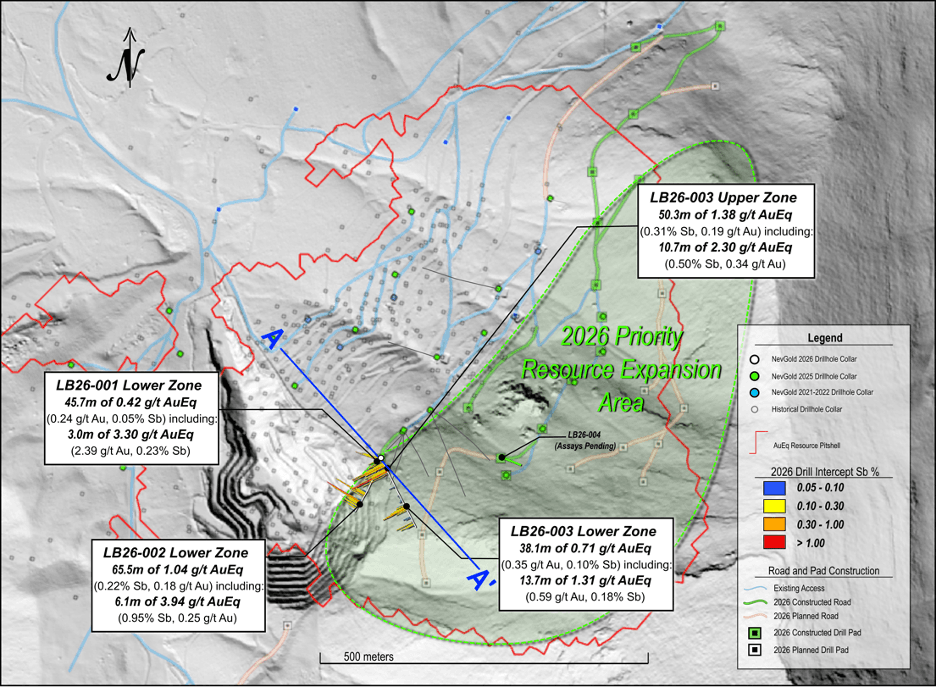
Figure 1 – Resurrection Ridge resource area with completed 2026 drilling. Figure includes outline of 2026 AuEq. resource pitshell, priority expansion area for ongoing 2026 drilling, and Sb intercepts for completed 2026 drilling. Ongoing road and pad construction efforts are also shown, highlighting focused efforts to expand Au and Sb mineralization to the east under the dolomite thrust.
Three holes in, the thesis is working.
But here's the thing about three holes.
They're just the preview.
Twenty-Five Holes in the Chamber
Buried in the release is the number that should matter most to anyone positioning ahead of the news flow:
Twenty-eight holes have already been completed in the 2026 program. Assays are pending on 25 of them.
The three holes that just expanded the resource beyond its own block model represent roughly one-tenth of the drilling already done—with the full roughly 20,000-meter program continuing through the season, focused on this expansion corridor and on converting Inferred material to the higher-confidence categories that engineering studies and government financiers require.
Twenty-five holes, drilled into the same structural corridor that just went three-for-three, are moving through the lab right now.
This is the cadence phase of the story—the stretch where a junior stops reporting in seasons and starts reporting in weeks. And if the first batch is any indication of what the Bullet Zone corridor holds, each batch of assays is another swing at pushing the invisible wall farther east.
A cadence like that only matters, of course, if a company can afford to sustain it. Plenty of juniors have drilled themselves into a financing at the worst possible moment.
That's not the setup here.
In May, NevGold closed an upsized C$42.2 million financing—a no-warrant deal priced at C$1.90 per share and backed by incoming institutional investors—with proceeds directed to advancing Limousine Butte and its other projects. The 20,000-meter program is funded. And per the August 25 release, the Preliminary Economic Assessment and engineering studies are now in process—the next rung on the ladder we described in July, the one that turns a counted resource into an economic case.
Which brings us back to the clock. Because while NevGold drills, the calendar that made antimony a national-security story in the first place keeps ticking.
Ninety-Four Days
When we first laid out the antimony supply-chain crisis in April, in "They Left a Fortune in the Desert", and again in "A Trillion-Dollar Trade Hiding in Plain Sight", the facts were stark: the United States mines essentially no antimony domestically, China dominates global supply and refining, and in December 2024 Beijing banned antimony exports to the United States outright.
The November 2025 trade truce suspended that ban—but only until November 27, 2026. And the prohibition on sales to U.S. military end users was never lifted.
From the date of NevGold's announcement, that expiry is ninety-four days away.
Washington has already shown you its playbook for exactly this situation. Perpetua Resources—the only company with a defined antimony reserve in America—received roughly US$75 million in Department of Defense awards and a US$2.9 billion EXIM loan. When we wrote to you in July, the market valued it at roughly US$2.4 billion, with first production not expected until around 2029.
The trigger for all of that capital was a defined, compliant resource Washington could underwrite.
NevGold now has that number—roughly 237 million pounds of contained antimony, larger than Perpetua's publicly disclosed resource and at a higher average grade, in oxide form that can potentially avoid conventional smelting.
And as of August 25, that number is officially growing.
The Starting Count Is Moving
Let's put the whole picture in one place:
-
Forty-one days after the maiden MRE, the first three holes of 2026 expanded it—mineralization was intercepted more than 100 meters outside the block model, at grades consistently above the resource average, starting at surface.
-
The same holes converted waste blocks to ore inside the existing pit shell and upgraded Inferred material.
-
Twenty-five more holes are already drilled, with assays pending—the beginning of sustained news flow from the same corridor that just went three-for-three.
-
The program is funded following a C$42.2 million institutional financing, with the PEA and engineering studies underway.
-
And the geopolitical clock—the November 27 expiry of China's export-ban suspension, with the military end-user ban still fully in force—is now inside one hundred days.
In July, we made a claim that was, at the time, a geological argument: that the largest antimony resource in the United States had been defined without the best rocks on the property, and that the maiden count was only where the story starts.
As of August 25, it's no longer just an argument.
All three released drill holes hit significant mineralization—and hit strong numbers.
But there are twenty-five more on the way.
That is a strong setup for a junior miner advancing two strategic commodities: gold and antimony.
Seek the truth and be prepared,
Carlisle Kane
The Equedia Letter
NevGold Corp.
Canadian Trading Symbol: NAU
U.S. Trading Symbol: NAUFF
German Trading Symbol: 5E50
Disclosure: This letter is disseminated on behalf of NevGold Corp. Equedia owns shares in NevGold Corp. Mineral resources are not mineral reserves and do not have demonstrated economic viability; Inferred resources are considered too speculative geologically to have economic considerations applied to them that would enable them to be categorized as mineral reserves. Drill intercepts reported are downhole thicknesses; true widths are approximately 70–90% of downhole thickness. Gold-equivalent values are as reported by NevGold based on assumed prices of US$3,000 per ounce gold and US$40,000 per tonne antimony and assumed recoveries of 80% for gold and 75% for antimony. All drill results and resource figures are sourced from NevGold's news releases dated August 25, 2026 and July 15, 2026; financing details are from NevGold's news release dated May 12, 2026; Perpetua figures are from Perpetua Resources' public disclosures as referenced in our July 15, 2026 letter. Always conduct your own due diligence before investing. See full terms and disclaimer.