The Count Just Got Bigger. Again.
NevGold's newest assays hit oxide gold at roughly three times the grade of its maiden resource, both outside the pit shell and inside blocks that were counted as waste.
by Equedia4 min read
Disseminated on behalf of NevGold Corp.
Dear Reader,
In August, we explained why a Mineral Resource Estimate is a starting count rather than a ceiling. A block model can only count rock the drills have touched, and where the data stops, the model draws an invisible wall. Everything past that wall is carried as zero.
Three weeks later, NevGold Corp. (TSXV: NAU | OTCQX: NAUFF) has released four more holes from its 2026 program at Limousine Butte, Nevada, and two of them did precisely what the drilling was designed to do.
What the drills found
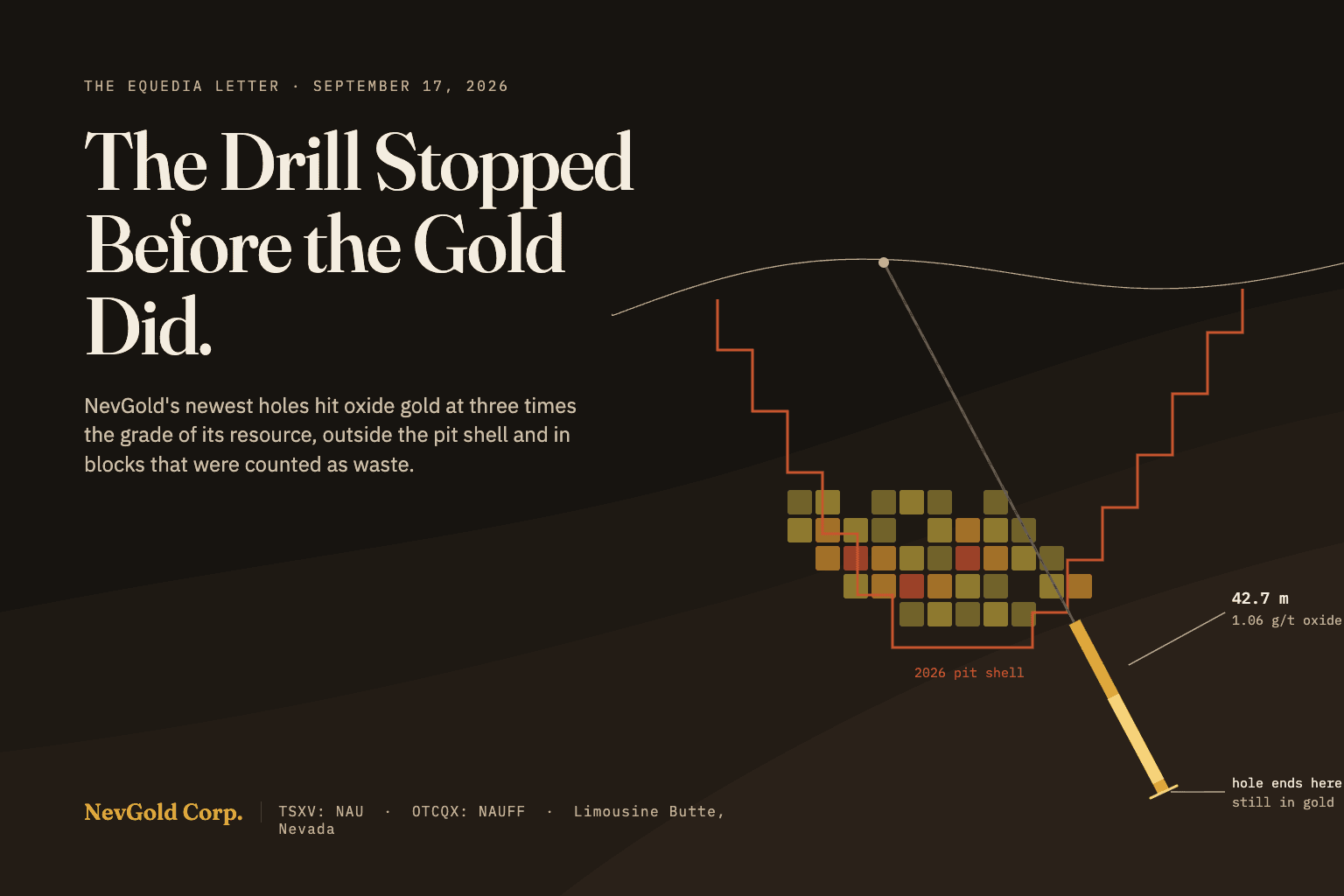
Hole LB26-007 cut 42.7 metres grading 1.06 g/t oxide gold, including 18.3 metres at 1.89 g/t, between 242 and 285 metres down the hole. That interval sits outside the pit shell of the July 15 resource. It also ended at the bottom of the hole while still in mineralization, with the final sample running 0.52 g/t, which means the drill stopped before the gold did.
Hole LB26-004 cut 27.4 metres at 1.23 g/t oxide gold, including 3.0 metres at 5.00 g/t. This one landed inside the pit shell, through blocks the July model had classified as unmineralized. NevGold says the hole converted those blocks. In plain terms, rock that was counted as waste two months ago now has a claim to being ore.
The upper part of LB26-007 also returned 16.8 metres at 0.20% antimony near surface. That was an infill hole, meaning it was drilled between existing holes to confirm the antimony zone is where the model says it is, and it did.
Why 1.06 g/t is a big number here
At a narrow-vein underground mine, one gram per tonne would be unremarkable. Limo Butte is a different kind of deposit. It is a 100% oxide, Carlin-type system where the July resource averaged 0.37 g/t gold in the Measured & Indicated category and 0.32 g/t in the Inferred category. Oxide gold at those grades is mined in bulk and processed by heap leaching, where crushed rock is stacked on a pad and the gold is dissolved out. It is the lowest-cost way to produce gold, which is why such low grades work.
So a 42.7-metre intercept at 1.06 g/t is roughly three times the average grade of the resource it is expanding, and the 5.00 g/t stretch in LB26-004 is more than thirteen times. When new holes come in above the model's average grade, a resource can grow on two fronts at once: more tonnes and a better grade per tonne. That is exactly the pattern the first three holes of 2026 showed in August, and it just repeated.
Grade also matters more the deeper you go. Rock outside a pit shell has to justify the extra waste stripped to reach it, and a zone running one gram makes a far stronger argument for a deeper pit than one running a third of that. Whether the LB26-007 intercept is captured in the next pit is a question for the engineers, but this is the kind of intercept that moves the boundary.
One caveat we always give: these are downhole lengths, and NevGold estimates true widths at roughly 70% to 90% of the reported thickness.
Two mineralizing events, one deposit
CEO Brandon Bonifacio offered a geological interpretation in the release that is worth translating. NevGold's team believes the gold and the antimony were deposited in the same general area during two separate mineralizing events, which is why certain parts of the deposit are higher-grade oxide gold and others are higher-grade oxide antimony.
For investors, that means the two metals are not competing for the same rock. A deposit with distinct gold-rich and antimony-rich zones gives the operator flexibility in how it sequences development, and the company flagged that flexibility as a reason it matters. Antimony is the strategic story we laid out in April in "They Left a Fortune in the Desert," with China's export-ban suspension expiring November 27 and the U.S. military end-user ban still in place. Gold at three times the resource grade is a second leg the market has paid less attention to.
What comes next
Only seven of the forty holes drilled this year have been reported. Assays are pending on the other thirty-three. Roughly 9,000 metres of the planned 20,000-metre program are complete, two rigs are turning, and the drilling remains focused on the Bullet Zone and Armory Fault, the corridor east of Resurrection Ridge beneath the dolomite thrust that we described in July as the rug shoved over the floorboards.
NevGold has more than $45 million in treasury, is funded for the next 12 to 18 months, and has a Preliminary Economic Assessment and engineering studies in process. Every batch of assays from here is another chance to push the wall.
To learn more about this story, see our previous more in-depth report, "One Number Turned a Forgotten Stock Into a $2.4 Billion Giant."
Seek the truth and be prepared,
Carlisle Kane The Equedia Letter
Disclosure: This is disseminated on behalf of NevGold Corp. Equedia owns shares and warrants in NevGold Corp. Mineral resources are not mineral reserves and do not have demonstrated economic viability. Drill intercepts are downhole thicknesses; true widths are approximately 70–90% of downhole thickness. Gold-equivalent values are as reported by NevGold based on US$3,000/oz gold and US$40,000/tonne antimony with assumed recoveries of 80% and 75%, respectively. Drill results and resource figures are from NevGold's news releases dated September 17, August 25, and July 15, 2026. Always conduct your own due diligence. See full terms and disclaimer at equedia.com/terms-of-use.