This Could Kill the Stock Market: The 10 Year Treasury
A look at the 10 year treasury yield and why its the most important indicator for stock market performance, and the amount of leverage used by hedge funds.
by Equedia6 minute read

This Could Kill the Stock Market: The 10 Year Treasury
Dear Readers,
A couple of years ago, I wrote that the S&P 500 would surpass the 1500 mark. This was during a time when investors were worried, the market appeared to be headed lower, and volume was non-existent.
Many doom and gloom experts called me a sucker. Some said I was crazy for thinking the market had the gusto to even move through 1400. They told me the fundamentals simply weren’t there.
And they were right.
The fundamentals for growth weren’t there – and they still aren’t.
Corporate earnings continue to beat analyst estimates but have seen so many downward revisions that beating market expectations doesn’t exactly mean there’s growth.
Housing starts and construction data are showing positive signs, yet mortgage applications continue to fall. I mentioned this a month ago, whereby mortgage applications dropped by 29% over an 8-week period – the biggest plunge in 30 months.
It dropped another 3% last week.
Unemployment remains lackluster and despite all of the good news you hear about more jobs being created, it’s not as rosy as it appears. I mentioned this many times before, but to sum it up:
“Of the 953K jobs that have been created so far this year, 731k of them were part-time jobs. That means only 23% of the newly created jobs, were full-time.”
Take a look at these charts:
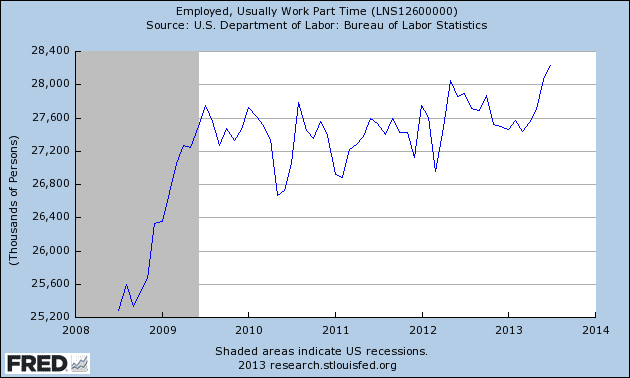
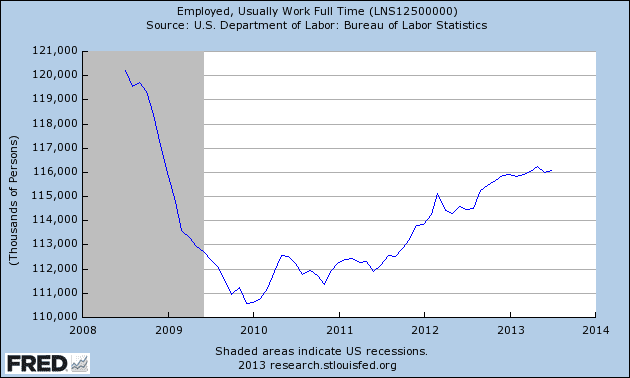
But hey, at least jobs are being created.
So the “experts” were right: from a fundamental growth perspective, the market should not have gone passed 1500.
So why then did I argue that the market was going higher?
Herein lies the simplest answer to a very hard question.
Artificially Inflated Assets
Print money. Put that money into the system. Inflate prices.
Bernanke and his crew can use whatever term they desire: QE, operation twist, and low interest rates – it doesn’t matter. It’s all the same. Create money and cheap credit and put it into the market.
It took some time for that money to enter the system, but now that it’s going in, the stock market has only one way to go, and that’s up.
But what happens when the money stops?