醫療保健成本已達到危機水平。
根據Centers for Medicare & Medicaid Services的數據,僅在2021年,美國人在醫療保健上的支出就高達4.3兆美元——相當於每人近13,000美元,佔全國GDP的18.3%。
與十年前醫療保健總支出約2.9兆美元相比,你會發現驚人的近50%增長。
這一趨勢如此陡峭,以至於到2030年,支出可能超過6.8兆美元,讓企業、政府計畫和普通民眾都喘不過氣來。
不僅僅是美國。
2020年,全球醫療保健支出總計約8兆美元。其中,歐洲佔2兆美元,而美國貢獻了3.5兆美元。
預計這項支出將以每年超過5%的速度增長——快於全球整體經濟的增長速度。
儘管2024年的數據尚未公佈,但根據歷史趨勢和部分數據,5%的速度使總額達到11-12兆美元。
同時,Centers for Medicare & Medicaid Services預計2024年約為5.15兆美元——再次有望佔美國GDP的18%。
換句話說,如果我們不對這場與醫療保健相關的金融危機採取行動,當前的全球債務危機將以驚人的方式爆發。
這甚至還不包括其他財務義務,例如social security。
但仍有希望——如果我們現在投入資源。
一線希望
在這個預算緊繃的現實中,一個迅速浮現的一線希望是:一場由診斷、機器人技術,以及最重要的是人工智慧(AI)推動的醫療保健革命。
數十億美元的venture capital正湧入那些承諾改變我們診斷、治療並最終預防疾病方式的公司。這就像是dot-com boom——但這次,它關乎拯救生命並在此過程中為我們所有人節省一大筆財富。
這不是遙不可及的夢想。它正在全球範圍內發生。如果您想親身體驗未來——一個可能保護您免受醫療費用飆升影響的未來——請密切關注。
AI驅動的突破將定義未來十年的醫療保健,而引領這一潮流的公司的stocks可能會skyrocket。
Venture Capital:醫療保健創新的億萬美元命脈
醫療保健並不便宜。它是一個每年耗盡錢包和政府金庫的兆元巨獸。
但看看幕後正在發生的事情:醫療保健領域的venture capital investment達到了歷史新高。
根據Silicon Valley Bank的2024 Healthcare Investments and Exits Report,僅在2024年,醫療保健VC funding就飆升至驚人的23 billion美元——高於2023年的20 billion美元。
根據Dealroom的數據,2024年biotech、pharma和health tech的總投資高達68 billion美元。
這比robotics、fintech、transportation、energy,甚至semiconductors的投資都要多。
看一看:

2021年,健康、biotech和pharma領域的Total venture capital達到124B美元的峰值,高於2015年不到30B美元的水平。
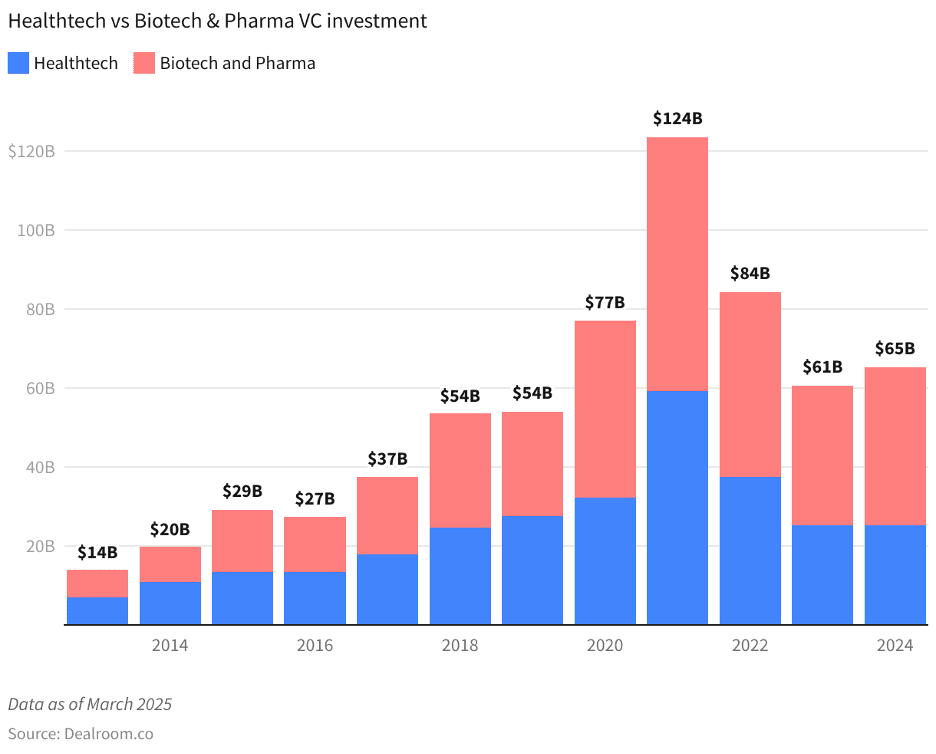
幾乎30%的醫療保健VC funding直接流向了AI驅動的公司。
像Innovaccer,籌集了2.75億美元以強化其AI驅動的醫療保健數據平台,正處於這場轉型的最前線。Emerson Collective——由Silicon Valley最具影響力的人物之一領導——剛剛向Hippocratic AI 投資了1.41億美元,旨在開發能夠處理從患者分流到後續護理等一切事務的AI代理。
如果您看到了一個模式,那麼您是對的:venture capitalists已將醫療保健AI視為金礦,並且他們正在大舉押注。事實上,自2020年以來,整個醫療保健領域的investment增長了44%,其中AI是主要驅動力。
翻譯:不斷上漲的醫療保健成本正在助長一場investment frenzy——這場狂潮可能會以比naysayers想像的更快的速度重塑整個行業。
AI三位一體:診斷、藥物開發和手術
AI不僅僅是一種時尚或華而不實的marketing tool。它是一個fundamental game-changer,正在overhauling醫療保健的每個角落。
讓我們關注三個關鍵領域。
診斷:在疾病找上您之前發現它們
在診斷cancer或heart disease等危及生命的conditions時,速度和準確性可能意味著生與死的區別。AI驅動的imaging tools在判讀X-rays、MRIs和CT scans方面已經outpacing human specialists。它們不僅速度更快,而且通常更精確——透過預防misdiagnoses和late-stage interventions,潛在地節省數十億美元。
公司正在利用AI streamline diagnostic workflows,reducing wait times和cutting costs dramatically。同時,liquid biopsies——simple blood tests that detect cancer——在AI的引導下變得更加強大(source: Nature)。
我們正在看到來自Breath Diagnostics, Inc.的驚人創新(雙關語),該公司正在開發一個僅需一次breath test即可診斷疾病的平台。當與AI結合時,該過程在最近的一項研究中顯示出「insane accuracy」(source: _Nature Scientific Reports_),突顯了diagnostics技術的進步速度有多快。
透過Nature:
「…exhaled breath中的VOCs透過micro-reactor approach捕獲,並使用mass spectrometry進行quantified。CT和breath markers被input到一個deep-learning autoencoder classifier中,並採用leave-one-subject-out cross validation進行nodule classification。
…The CAD system achieved 97.8% accuracy, 97.3% sensitivity, 100% specificity, and 99.1% area under curve in classifying pulmonary nodules。」
想像一下,只需一次呼吸就能detect diseases。這聽起來像是future…但它closer than ever。
藥物開發:將十年縮短為數月
Developing a new drug used to take years—sometimes over a decade—and cost billions。AI正在compress that timeline like never before,sifting through massive data sets to pinpoint promising drug candidates in a fraction of the time。它還revolutionizing clinical trials by predicting outcomes和refining patient selection。
No wonder investment in biopharma AI has skyrocketed by 300% since 2023。像Insitro這樣的公司正在blazing the trail,使用AI accelerate drug discovery for some of the most devastating diseases on the planet—from Alzheimer’s to cancer。
手術:機器人精準度與人類智慧的結合
In operating rooms worldwide,surgical robots are taking center stage。
But they’re more than glorified mechanical arms—they’re powered by advanced AI that makes procedures safer, faster, and less prone to human error。
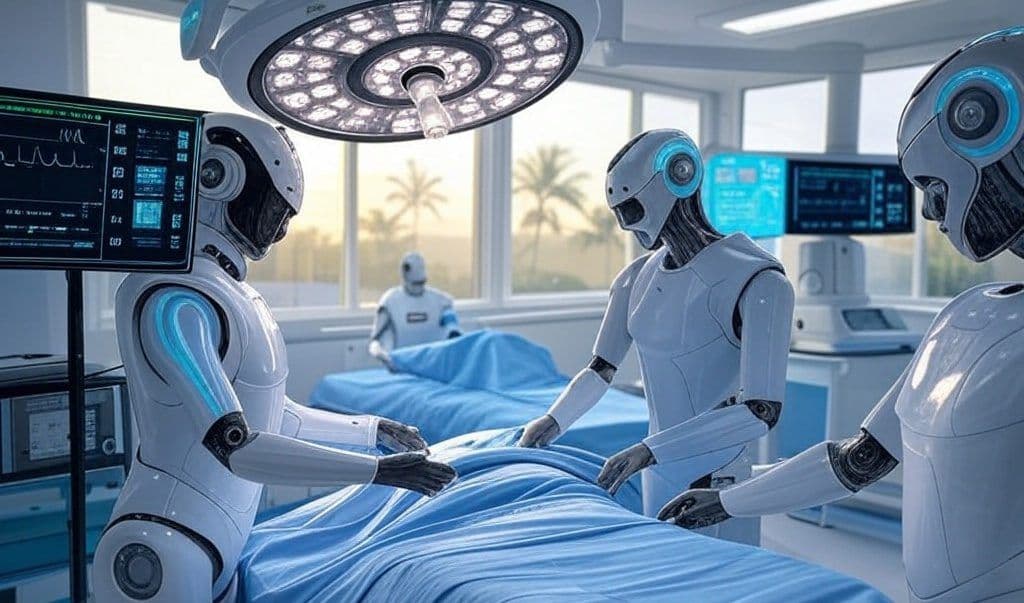
Intuitive Surgical,the maker of the da Vinci system,is integrating AI to guide robotic surgery with near-flawless precision。The result is shorter wait times, quicker recoveries, and lower costs for patients and providers alike。
從8週到4小時
如果您想了解這場transformation的速度有多快,look no further than Hawaii。
您可能認為它是一個blissful tourist destination—but right now,它也是地球上一些most advanced healthcare innovations的proving ground。
Hawaii’s new Advanced Lung Institute就是一個完美的例子。
Thanks to cutting-edge technology and AI-driven techniques,surgery wait times could plummet from an excruciating 8 weeks to just 4 hours,根據Hawaii’s new Advanced Lung Institute的說法。Let that sink in: a procedure that used to require two months of anxious waiting can now be done in a single afternoon。
而且這不僅僅是關於lung procedures。
Across the Hawaiian Islands,telemedicine和predictive analytics are stepping up to bridge critical gaps in care—especially in remote areas like Kauai or Molokai,where travelling to Honolulu for specialized treatment can be a logistical nightmare。
By identifying at-risk patients early and coordinating resources more efficiently,these AI-based solutions are slashing costs and saving lives in one of the most geographically challenging healthcare environments in the United States。
獲利機會
The healthcare AI market is expected to grow at a scorching compound annual growth rate (CAGR) of over 40% for the next decade。It’s no wonder stocks likeIntuitive Surgicalhave continued to trend higher,tripling in share value over the last five years。
為什麼?Because rising healthcare costs aren’t going away—and these companies are providing solutions that drastically cut expenses while improving patient outcomes。Think of it as the perfect storm for investors: a massive market in desperate need of innovation,paired with cutting-edge tech that finally delivers real results。
And let’s be honest: when you can reduce an 8-week surgical backlog to a same-day procedure,the entire industry takes note。As these breakthroughs move from pilot projects to mainstream adoption,you can bet the biggest winners will be the early investors in AI-driven healthcare。
不要被愚弄
But there is a caveat。While AI in healthcare is revolutionary,you should be cautious of smaller startups that heavily promote AI as their core strength。Effective AI relies on vast amounts of data—the more,the better。
Take Tesla,for example。Even with its unmatched real-world data,Tesla has yet to master autonomous driving fully。
So,when evaluating AI health companies,prioritize those with a solid foundation that doesn’t depend solely on AI for success—because in fields like diagnostics,the quality of the outcome depends on the quality of the input。
Seek out technologies that function effectively without AI,where AI serves as an enhancement rather than the entire solution。
In AI-driven diagnostics,tools like medical imaging analysis (e.g.,for detecting cancer in X-rays or MRIs) rely heavily on the quality of input data。For instance,if an AI model is trained on a dataset of high-resolution,well-labelled images from diverse patient populations,it can accurately identify abnormalities like tumours or fractures。
However,if the input data is poor—say,blurry images,incomplete patient histories,or a biased dataset lacking diversity (e.g.,only images from one demographic)—the AI might miss subtle signs of disease or produce false positives。A real-world example is the use of AI in detecting diabetic retinopathy: models trained on clear retinal scans with detailed annotations outperform those fed low-quality scans or unverified labels,directly impacting diagnostic accuracy。
In robotic-assisted surgery,AI systems like the da Vinci Surgical System depend on precise input from sensors,cameras,and preoperative imaging to guide instruments。
If the input is high-quality—sharp 3D visuals,accurate patient anatomy mapping,and real-time feedback from the surgical field—the AI can enhance a surgeon’s precision,reducing tissue damage and improving outcomes。Conversely,if the input is flawed (e.g.,distorted images due to equipment malfunction or outdated scans that don’t reflect current tumour growth),the AI might misguide the robot,leading to errors like cutting healthy tissue or missing critical areas。The success of AI in minimally invasive procedures,such as prostatectomies,hinges on this input fidelity。
Then there’s drug discovery and personalized medicine,where AI models predict how compounds interact with biological targets or tailor treatments to individual patients。
For example,in pharmacology,AI systems like those used by companies such as BenevolentAI analyze vast datasets of molecular structures,clinical trial results,and patient genetics。If the input data is comprehensive and accurate—high-quality genomic sequences,detailed trial outcomes,and well-documented side effects—the AI can identify promising drug candidates or optimize dosages effectively。But if the input is spotty,such as incomplete patient records,contaminated lab samples,or poorly curated chemical libraries,the AI might suggest ineffective drugs or overlook toxic interactions。
A case in point is AI-driven pharmacogenomics: accurate genetic profiles lead to better predictions of drug response,while errors in sequencing data can result in harmful prescriptions。
In each domain,garbage in equals garbage out。High-quality,well-structured input data empowers AI to deliver reliable,life-saving results,while subpar inputs undermine its potential and risk patient harm。
Be extremely wary of the healthcare companies that rely only on AI。
結論
Rising healthcare costs are here to stay—that’s just a fact of modern life。But that same pressure is fueling a revolution that could change the way we approach medicine forever。From AI-powered diagnostics catching cancer earlier to robotic surgeons minimizing hospital stays,the face of healthcare is undergoing a radical shift。
And the investment case? It’s tough to overstate。We’re staring down a once-in-a-generation chance to put your money into a sector that’s not only on the cusp of explosive growth but also poised to save lives and livelihoods。That’s a win-win that doesn’t come along very often。
The bottom line: whether you’re concerned about your own medical bills or looking for the next big thing to supercharge your portfolio,AI-driven healthcare is the space to watch。It’s not just a bet on technology; it’s a stake in a healthier,more cost-effective world—and that’s the kind of investment that can pay dividends far beyond the balance sheet。