Wie Geld funktioniert und was es heute bedeutet
Hier ist ein Blick darauf, wie Geld wirklich funktioniert und was es für die Weltwirtschaft, einschließlich des Handelskriegs zwischen den USA und China, bedeutet.
von Equedia16 minute read

Liebe Leser,
Von UFOs und durchgesickerten Dokumenten, die zeigen, dass die Regierung mit außerirdischer Technologie experimentieren könnte, bis hin zu einem weiteren knappen Vorfall mit dem Iran – die Welt scheint einfach nicht zur Ruhe zu kommen und sich selbst zu verstehen.
Währenddessen steigt der Aktienmarkt trotz aller globalen Unsicherheit weiter an – und erreichte letzte Woche ein weiteres Allzeithoch.
Hätten Sie Ihr Geld an die Seitenlinie verschoben, hätten Sie einen schönen und einfachen Gewinn von 19 % verpasst – einfach durch Investitionen in den S&P 500.
Und trotz dessen, was Ihnen die Bären und Analysten erzählen, habe ich Ihnen wiederholt gezeigt, wie Sie den Markt anhand eines der genauesten Marktindikatoren einschätzen können.
Wenn Sie nicht wissen, was das ist, können Sie es sich ansehen, indem Sie hier klicken: Der **genaueste Marktindikator**
Heute möchte ich einen Brief wieder aufgreifen, den ich 2016 geschrieben habe.
Warum?
Denn er liefert nicht nur viele Antworten darauf, warum der Aktienmarkt steigt, sondern hilft uns auch, den Handelskrieg zwischen den USA und China einzuschätzen und zu verstehen.
Und da Gold erneut US$1400 per ounce überschreitet – etwas, das wir seit fast sechs Jahren nicht mehr gesehen haben – könnte es Ihnen auch helfen zu verstehen, warum Gold steigt und wohin es als Nächstes gehen könnte.
Los geht's.
Sehen Sie sich stattdessen das Video an:
Wie Geld funktioniert
( Der Equedia Letter, September 2016)
Ein Massenexodus des Reichtums steht bevor.
Es wird ein katastrophales Ereignis sein, wie es unsere Welt noch nie gesehen hat.
Es wird so mächtig sein, dass alle früheren Finanzkatastrophen wie ein Blumenbeet aussehen werden.
Doch entgegen dem, was Sie vielleicht denken, bin ich stärker am Markt investiert, als ich es seit sehr, sehr langer Zeit war.
Aber warum? Wäre das nicht ein direkter Widerspruch zu dem, was ich gerade gesagt habe? Sollten wir den Markt nicht verlassen, wenn eine solche Finanzkatastrophe bevorsteht?
Um dies zu beantworten, erkläre ich die Dinge am besten aus einer Makroperspektive.
Der Hauptgrund für den Kollaps
Jeder Wirtschaftsboom der letzten Jahrhunderte entstand infolge der Kreditexpansion.
Jeder Wirtschaftsabschwung entstand ebenfalls infolge der Kreditexpansion.
Gehen wir also in der Zeit zurück, um zu verstehen, warum.
Als die Dinge einfach waren

Vor nicht allzu langer Zeit wurde der Handel zwischen Ländern durch den Austausch von Waren und Dienstleistungen abgewickelt.
Der Einfachheit halber verwenden wir in dieser Geschichte Gold als Tauschwährung – da jede Nation Gold damals als Geld betrachtete.
Vor einigen hundert Jahren war der Handel zwischen den Engländern und den Niederländern stark.
Als die Engländer mit der Niederländischen Republik handelten und mehr importierten als exportierten, hatten die Engländer ein Handelsdefizit.
Um dieses Handelsdefizit, zu begleichen, schickte England Gold als Zahlung an die Niederländische Republik.
Da Gold die einzige echte Form von Geld war, würde Englands Geldmenge schrumpfen.
Diese Kontraktion bedeutete, dass englische Banken weniger Geld zum Verleihen hatten, was wiederum bedeutete, dass die Zinsen steigen würden, weil die Kreditkosten stiegen, was wiederum bedeutete, dass weniger Geld für das Wirtschaftswachstum zur Verfügung stand.
Wenn dies so weiterginge, würde es schließlich zu einer englischen Rezession führen, und es käme zu einer Deflation.
Aber das Gegenteil würde den Niederländern widerfahren.
Der Handelsüberschuss bedeutete, dass die Niederländer mehr Gold hatten – und da Gold die einzige echte Form akzeptabler Währung war, wuchs ihre Geldmenge.
Die erhöhte Geldmenge bedeutete, dass die Niederländer mehr Geld zum Verleihen hatten, was das Leihen billiger machte und somit den Kredit ausweitete, was zu einem Wirtschaftsboom führte, der schließlich Inflation verursachte.
Mit mehr Geld kauften die Niederländer mehr englische Waren, die infolge der englischen Deflation billiger waren.
Die Engländer hingegen hatten weniger Geld und konnten nicht so viele niederländische Waren kaufen, weil niederländische Waren infolge der Inflation teurer waren.
Schließlich würde Englands Handelsdefizit mit der Niederländischen Republik wieder ins Gleichgewicht kommen.
Mit anderen Worten, die internationale Handelsbilanz wurde durch die Verwendung von Gold als Geld aufrechterhalten.
Aber dieses Gleichgewicht hielt nur so lange an, wie das Geld nicht manipuliert wurde.
Erster Weltkrieg
Vor dem Ersten Weltkrieg funktionierte die Welt nach einem Goldstandard – wobei Gold die einzige weltweit akzeptierte Geldform war.
Doch als der Erste Weltkrieg begann, hatte keines der Länder genug Gold, um den Krieg zu finanzieren.
Was taten sie also?
Sie druckten Geld, um alle Staatsanleihen und Defizitausgaben zu finanzieren, die zur Finanzierung des Krieges erforderlich waren.
Als der Krieg vorbei war, wurde so viel Geld aus gedruckten Schulden geschaffen, dass dies einen globalen Wirtschaftsboom anheizte, der von westlichen Nationen angeführt wurde.
Wir kennen diesen Boom als die Goldenen Zwanziger.
Amerikanische Unternehmen verzeichneten Rekordproduktionszahlen, steigende Umsätze und Millionen von Dollar an Gewinnen. Diese Gewinne führten zu hohen Dividenden und noch höheren Aktienkursen. Tausende von Investoren strömten an die Börse, und viele verschuldeten sich und liehen sich Geld, um noch mehr zu kaufen.
Niemand dachte, dieser Boom würde enden.
Doch amerikanische Unternehmen begannen so viel zu produzieren, dass sie mehr Waren herstellten, als die Verbraucher kaufen konnten.
Dies wiederum führte zu sinkenden Umsätzen, Preisen und Gewinnen.
Und mit all den Schulden, die während des Krieges und des darauf folgenden Booms angehäuft wurden, konnte ein Großteil davon nicht zurückgezahlt werden.
Dies führte zur Panik von 1930.
Als 1930 ein Großteil der Schulden nicht zurückgezahlt werden konnte, kollabierten der US-Aktienmarkt, die Geldmenge und das Bankensystem. Dies führte zum Zusammenbruch des internationalen Währungssystems, was wiederum zum Zusammenbruch des Welthandels führte.
Im nächsten Jahrzehnt steckte die ganze Welt in einer Krise, die als Große Depression bekannt wurde.
Die Große Depression hatte tiefgreifende Auswirkungen auf die amerikanische Gesellschaft und die Welt. Millionen von Menschen verloren ihre Arbeit und ihre Häuser. Tausende verhungerten. Die Selbstmordraten schossen in die Höhe.
Während die Depression noch tobte, begann der Zweite Weltkrieg.
Zweiter Weltkrieg
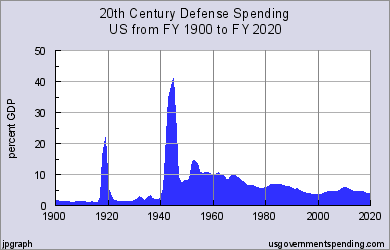
Als der Zweite Weltkrieg vorbei war, brauchte die Welt ein neues Finanzsystem – eines, dem globale Handelspartner vertrauen konnten, und eines, das Währungsmanipulationen mit strengen Finanzkontrollen verhindern konnte.
Mit anderen Worten, die Welt wollte ein System, in dem Regierungen ihre eigene Währung nicht manipulieren konnten, um den Handel zu beeinflussen, und eines, in dem es keinen unfairen Anstieg schneller Kreditexpansion geben würde.
Der einzige Weg dazu war, ein System zu schaffen, das durch etwas gedeckt war, das nicht nur seinen Wert behält, sondern auch nicht manipuliert werden konnte.
Dieses Etwas war Gold.
Doch die Rückkehr zum Goldstandard bedeutete, dass für viele Nationen erneut Deflationssorgen aufkommen würden.
Darüber hinaus kontrollierten die US nach dem WW2 fast ein Drittel des weltweiten Goldes, und der internationale Handel konnte in einer Welt, in der eine Seite das gesamte Gold besaß, nicht existieren.
So wurde das Bretton Woods system geschaffen, wonach der US dollar als internationale Währung dienen sollte, gedeckt durch Gold zu einem festen Preis von $35 per ounce.
Unter diesem System hatten Länder, die US dollars hielten, das Recht, diese dollars zu US$35/oz in Gold umzuwandeln.
Dieses System funktionierte… aber nicht lange.
Fiskalische Überschwänglichkeit
Die US begannen in den 1960er Jahren, übermäßig viel auszugeben, um den Vietnam War und ihre vielen social welfare programs\
(*Genau wie die US und Canada es heute tun)
Das bedeutete, dass immer mehr Geld gedruckt werden musste, um all die überschwänglichen deficit spending von President Johnson zu finanzieren.
Aber die Federal Reserve konnte nicht einfach weiter Geld drucken. Warum?
Bis 1968 war jede Federal Reserve Bank verpflichtet, eine gold certificate reserve von nicht weniger als 25 percent gegen ihre Federal Reserve note liability zu halten.
Mit anderen Worten, wenn die Fed $100 dollars drucken wollte, brauchte sie Gold im Wert von mindestens $25 dollars.
Doch die US gold reserve war so stark geschrumpft, dass die Federal Reserve banks keine weiteren dollars mehr ausgeben konnten, weil sie nicht genug Gold zur Deckung hatten.
President Johnson erhielt also die Zustimmung des congress und hob das Gesetz auf, das die Fed verpflichtete, diese gold backing aufrechtzuerhalten.
Ab 1968 gab es im Inland keine Golddeckung mehr.
Der Wert des dollar stieg unterdessen weiter an. Infolgedessen stieg das US trade deficit weiter an.
Der steigende Wert des dollar machte es attraktiver, die dollars außerhalb der US zu investieren, sodass US banks und corporations begannen, noch mehr dollars in foreign nations such as Europe zu investieren.
Dies führte natürlich dazu, dass mehr dollars die US verließen, was ein ständig wachsendes trade deficit bedeutete.
Das Gleichgewicht des Goldes
Da die US government spending zusammen mit der uncertainty of government policies weiter stiegen, begannen foreign nations, die US dollars hielten, ihre dollars in Gold umzuwandeln.
Infolgedessen verloren die US die Hälfte ihrer gold reserves in den sechziger Jahren. Bis 1971 gab es viermal so viele dollars overseas, wie die US Gold zur conversion besaßen.
Im selben Jahr teilte President Nixon der Welt mit, dass sie ihre dollars nicht mehr in Gold umwandeln könnten.
Bis 1971 gab es international keine Golddeckung mehr.
Die Welt war schockiert und das globale Währungssystem brach zusammen.
Unter dem Bretton Woods system waren die currencies alle pegged at a fixed exchange rate, und trade – for the most part – war in balance.
Doch sobald Nixon die gold backing international aufhob, zusammen mit record government spending, the system collapsed.
Inflation auch took over und commodity prices skyrocketed. Oil, for example, went from $3.60 to over $35 in 10 years, climbing nearly 900%.
Fixed exchange rates wurden zu floating exchange rates, und trade imbalances begannen sich aufzublähen.
Via Cato Institute:
„Beginning in the early 1980s, annual U.S. trade deficits reached unprecedented levels. After decades of postwar surpluses, the U.S. trade deficit topped $100 billion in 1984 and peaked at a record $153 billion in fiscal year 1987.“
Most of this deficit was with Japan. And that meant a boat load of dollars went into Japan.
Der Niedergang Japans
Alle dollars, die in Japanese banks flossen, führten zu einem schnellen deposit growth.
Wenn Banken deposits halten, müssen sie diese ausleihen – andernfalls wären sie gezwungen, interest auf diese deposits zu zahlen.
Um Geld zu verdienen, müssen die Banken diese deposits also ausleihen – andernfalls würden sie Geld verlieren.
Alle dollars, die nach Japan gelangten, verursachten einen massive credit boom, der den Japanese stock market befeuerte und stocks trading at 100-times plus PE multiples hatte. Er ließ auch property prices skyrocketing.
But the surplus kept getting bigger and bigger because the US didn’t deflate because it didn’t run out of money. The US kept on printing and Japan kept on absorbing all of those printed US dollars.
Und hier kommt der Knackpunkt.
Wenn US dollars nach Japan gelangen, können die Japanese sie zu Hause nicht ausgeben, weil es nicht ihre currency ist. Sie müssen ihre dollars also in yen umwandeln, indem sie dollars for yen tauschen.
Doch wenn das passiert, verringert es die money supply of yen.
Dies würde den yen higher treiben und eventually take away the currency benefit of having a cheaper yen, leading to lower exports and a tumbling economy.
Es dauerte nicht lange, bis central banks around the world erkannten, dass ohne ein gold-backed system, they too could print money and use that money to buy dollars to hold down the exchange rate.
Schließlich platzte jedoch die Japanese economic bubble.
The bubble was so big that Japan is still battling deflation and is no bigger today than it was in 1993.
Das Plaza Accord
Between 1980 and 1985 the dollar had appreciated by about 50% against the Japanese yen, Deutsche Mark, French Franc and British pound – the currencies of the next four biggest economies at the time.
In order to fix the massive US trade deficit, these five nations reached an agreement to devalue the dollar. This became known as the Plaza Accord.
By 1987, the dollar devalued by as much as 51% against the Mark and the Yen.
By 1991, the devaluation brought the US trade back into balance.
Dieses Gleichgewicht hielt natürlich nicht sehr lange an.
China tritt auf den Plan
After the Plaza Accord, trade relations with China and the US “coincidentally” began to get better.
And with a massively devalued dollar, US corporations began looking elsewhere for cheaper labour.
This is where China starts coming into the global economy, along with other Asian countries.
The cheap workforce in Asia led to an increase in US trade, and so the US trade deficit grew once again.
By August 2006, the US trade deficit had grown to a record high of US$762 billion.
Das sind fast US$1.5 million, die die US jede Minute verlassen.
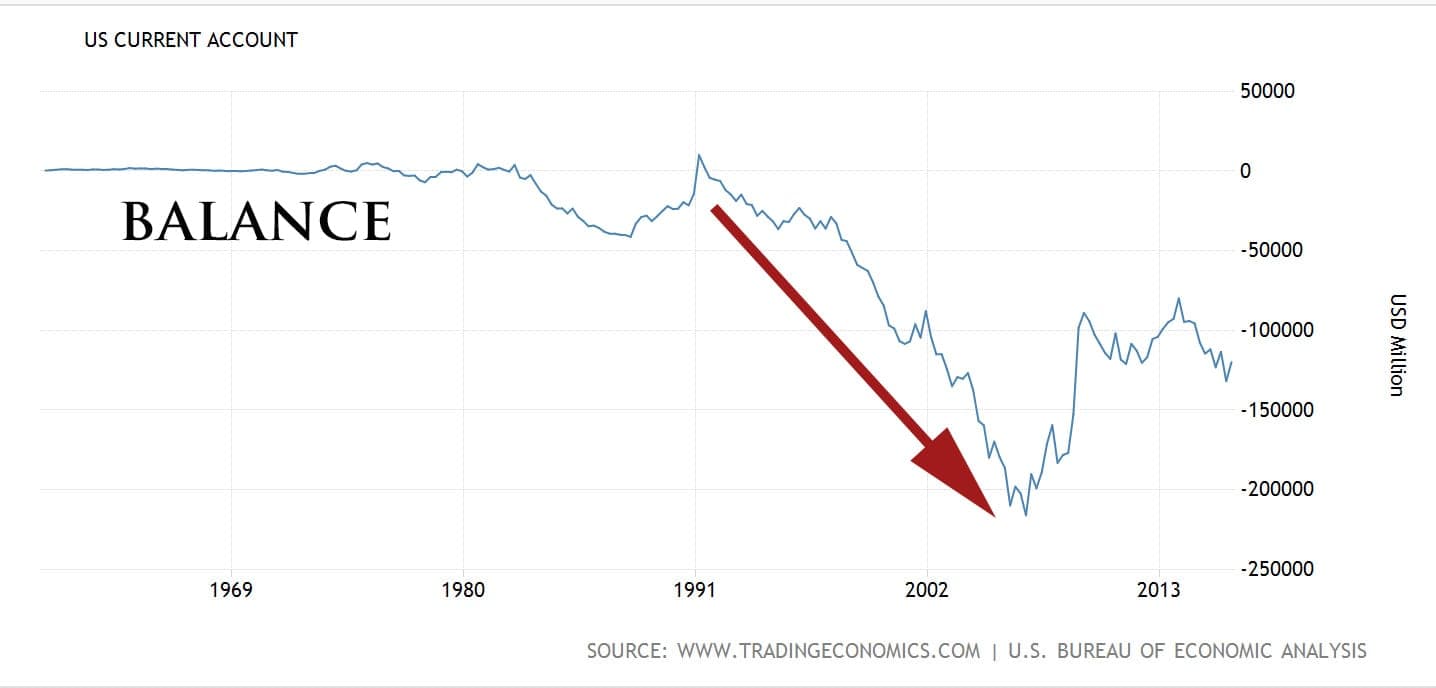
Dies war natürlich großartig für die globale Wirtschaft.
But as the US trade deficit got bigger with China, China’s surplus got bigger. That meant China now had a ton of money coming into the country.
And as we just learned in the case of Japan, when money enters China, it causes rapid deposit growth leading to rapid credit expansion. It also forces China to print money in order to hold down the exchange rate.
That’s how China’s foreign exchange reserves grew to over US$4 trillion, while Japan holds over US$1 trillion. That’s also why both Japan and China have printed trillions upon trillions of their own currencies.
Exponentielles Geldwachstum
When the US prints money, China and countries all around the world do as well. That means every dollar the US prints increases the global money supply exponentially.
Aber das ist noch nicht alles.
China and Japan can’t just leave the foreign reserves sitting in a bank because if they did, it would simply sit there and do nothing. So it has to invest it in US-dollar denominated assets such as US real estate, US stocks, and of course, US corporate and government bonds, otherwise known as debt.
Of course, this pushes the price of everything in the US higher including stocks and bonds. And when the prices of bonds go up, yields go down, so interest rates go lower and lower.
This massive amount of investment back into the US was what helped finance the bonds issued by Fannie Mae and Freddie Mac, who borrowed trillions of dollars, largely financed by these foreign central banks. This, along with low-interest rates caused by the bond-buying spree, pushed up property prices and created the property bubble that burst in 2007.
Wie Sie sehen können, fließt das gesamte Geld, das die US verlässt, zurück in die Finanzblase.
And the bigger that bubble became, the more money Americans had to buy things from China and Japan, thus fueling the bubble even further.
This is the main reason why the price of bonds and stocks in the US are so high and why interest rates are so low right now. It’s why real estate prices all over Canada have skyrocketed.
Es ist auch der Grund, warum wir uns in der größten Finanzblase befinden, die die Welt je gesehen hat.
Welche Erhöhung?
Was uns zurück zum heutigen Tag bringt ( beachten Sie, dass dies, obwohl ich es 2016 sagte, immer noch gilt).
When the 2008 financial crisis hit as a result of rapid credit expansion, the world tumbled.
Today, we’re in an even bigger financial bubble than we were in 2008 because, as I just explained, all of the dollars printed to fix the 2008 bubble has exponentially grown the global money supply and fueled an even bigger credit expansion worldwide.
Asset prices and the global economy are being held up by the rapid expansion of credit and low-interest rates around the world.
If, and when, interest rates rise, asset prices will crash and the economy would likely sink into a very deep recession – we already saw this occur (in 2015) when the Fed raised rates just slightly.
The question is, when will the central banks allow interest rates to rise? In most of the world, central banks aren’t allowing them to.
It is only in the US where the Fed has hinted at raising interest rates, yet fail to do it every time.
Even if the Fed does raise interest rates, you can bet that massive stimulus measures would follow.
A few weeks ago (nochmals, bedenken Sie, wir sprechen über 2016), I wrote the Letter, “ Can the Fed Buy Stocks?”
“Even more disturbing are the hints Yellen gave suggesting the Fed could break policy and consider “some additional tools that have been employed by other central banks.”
This, of course, includes buying a wider range of assets or raising the inflation target – both of which means the Fed will own more, for less.
It could also mean that the Fed may buy equities in the future.”
In other words, raising rates would undoubtedly be a threat to the economy and political stability – unless the Fed were to do something else.
So etwas wie QE4.
Und das würde einen weiteren massiven Anstieg der globalen Geldmenge bedeuten.
Tatsächlich sind Vorläufer von QE4 bereits da.
Immobilienblase wird größer
In May 2016, I wrote how America’s biggest banks were already being forced to lower their lending standards and thus creating the next housing bubble.
„Wells Fargo & Co. has started offering a new type of mortgage that requires a tiny down payment and could appeal to customers who might otherwise get loans backed by the Federal Housing Administration.
…They’re not the only ones offering these non-FHA, 3%-down, riskier mortgages.
Last week, JP Morgan announced the launch of a similar product…
The Bank of America also announced a similar program back in February.”
Es stellt sich heraus, dass Freddie Mac mitmachen will.
Via Realtor Mag from September 2016:
„In a new pilot program, Freddie Mac and two non-bank lenders are easing income and documentation requirements for mortgage borrower applicants.
The aim is to fuel more mortgage originations among first-time buyers, who tend to have more low to moderate incomes and to better reach those who live in underserved areas, The Wall Street Journal reports.
In the pilot program, Freddie Mac says that applicants will be able to use the income of others who live with the borrower but who aren’t going to be on the mortgage to qualify.
Also, income from second jobs that borrowers have held, even for a short period of time, can now be factored in. The program will also not require borrowers to come up with bank statements to show how they saved for their down payment.”
Wir erleben 2008 schon wieder – only on a much bigger scale\
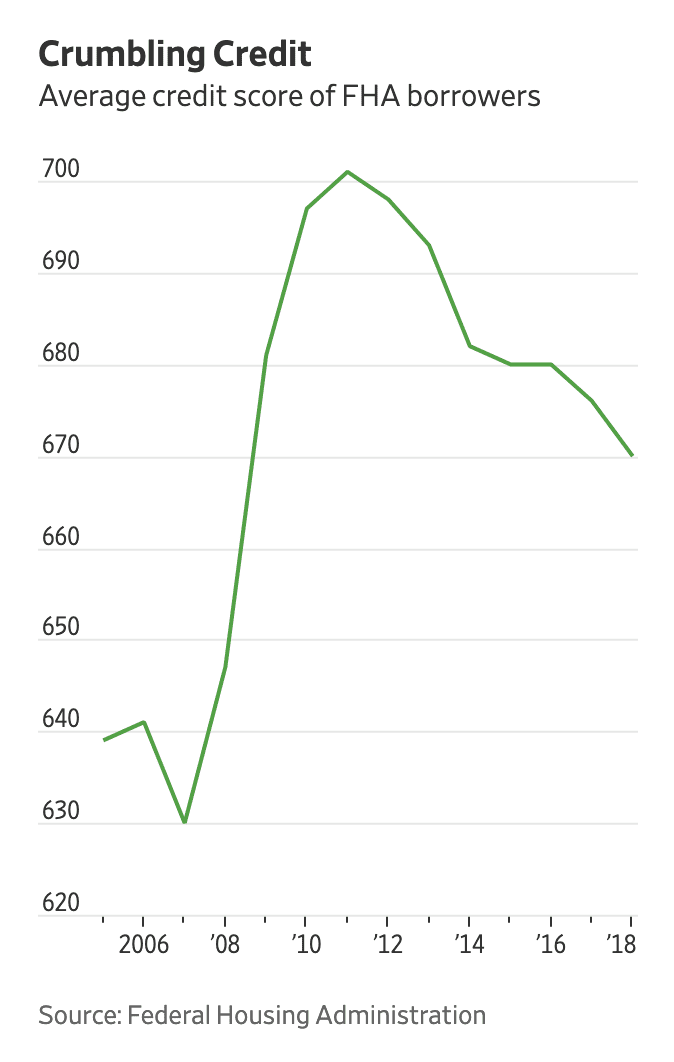
*Hinweis: Im March 2019, the Federal Housing Administration finally told lenders that it would begin flagging more loans as high risk:
„…The FHA’s decision to tighten underwriting standards could mean fewer first-time home buyers are able to get mortgages.
The move is an about-face from a 2016 decision to loosen underwriting standards. At the time, the FHA removed an earlier rule that required manual underwriting for mortgages with credit scores below 620 and a ratio of debt to income above 43%.
“Since that happened, we have observed a steady increase in the endorsement of higher-risk loans,” Mr. Becker said. The FHA has also been warning of rising risks in the portfolio that it insures in its annual reports submitted to Congress.”
Just take a look at the share of FHA borrowers whose debt payments are more than half of their income and the average credit scores of FHA borrowers:
Zurück zu meinem 2016 Letter…
China: Die nächste Große Depression?
China, now considered a global economic leader, has been producing an excessive amount of goods and excess industrial capacity.
In fact, in just three years from 2011-2013, China produced more cement than the US did in the entire 20th century combined!
It hasn’t slowed down and it’s eerily reminiscent of what led the US to the Great Depression.
I expect that while the US dollar has been strong in anticipation of a Fed hike, the US Dollar will likely fall against the Yen, Euro, Canadian, and Aussie dollar, going into the New Year and maybe even before.
Seien Sie also nicht überrascht, wenn Gold steigt, während der US dollar an Wert verliert.
Schmiede das Eisen, solange es heiß ist
Ich glaube, der einzige Weg, uns vor dieser schnellen Kreditexpansion zu schützen und vorzubereiten, besteht darin, so viel Vermögen wie möglich aufzubauen und es in die Dinge zu übertragen, die am wichtigsten sind, wie Ihr Zuhause.
Over the years, and including some of my more recent letters, I have told readers to take advantage of this massive financial boom.
From my 2016 Letter, “ Can the Fed Buy Stocks?“:
„…Our job is to protect our wealth based on (central bank) policies.
This includes everything from investing in and exiting the right areas at the right time.
(Yes, gold is just one of the viable long-term options in this regard.)
We’re in an era of cheap money and there is A LOT of it – but only if we put it to work.
Holding cash means you’re likely losing wealth over time. If you want to protect your wealth, you have to put it to work – that is the position the central banks have put us in.”
If we sit and risk nothing, we’ll see the value of our money depreciate very rapidly in this world of expanding money supply and credit.
We have been very lucky over the past years and have had some incredibly big winners.
I’ve fueled a lot of these profits into new – and more – investment opportunities, and will continue to do so until I see stronger signs that the “economic reset” button is about to be pushed.
Fazit
I wrote this Letter back in September 2016. And despite all of the uncertainty that has shrouded our global economy, stocks have moved higher.
Furthermore, this Letter gives us strong insight into what is happening now with the US-China trade war.
Despite all of US President Donald Trump’s attempts to balance the trade deficit with China, he will fail. Tariffs won’t be enough, nor will some sort of currency agreement where China agrees to holding their currency at a specific rate against the US dollar. It simply can’t happen under our current financial system.
While he may reach a deal to shrink the trade balance slightly, there is simply no way to balance it when money is now backed by nothing more than the promises of central banks.
Perhaps that’s why gold is once again rising and why inflows into gold have continued to climb all year.
If an agreement can’t be reached between China and the US, gold prices will likely go even higher. This, of course, means gold stocks should do very well in near-term.
Just keep in mind that for as long as interest rates remain low and the Fed continues to intervene, money will likely continue to flow into the stock market – which means gold will still take a backseat.
And while we have had many grand successes with gold stocks before, and believe we should maintain a small portion of our portfolio in these assets, we shouldn’t be too excited yet.
Gold is up 10% on the year, but the S&P 500 is up almost double that.
It’s time to once again to look at gold stocks, but don’t jump all the way just yet.
Bis zum nächsten Mal.
Suchen Sie die Wahrheit,
Ivan Lo
The Equedia Letter
Offenlegung:
Equedia.com and Equedia Network Corporation are not registered as investment advisers, broker-dealers or other securities professionals with any financial or securities regulatory authority. Remember, past performance is not indicative of future performance. This article also contains forward-looking statements that are subject to risks and uncertainties that could cause actual results to differ materially from the forward-looking statements made in this article. Just because many of the companies in our previous Equedia Reports have done well, doesn’t mean they all will.