How to Invest in Copper: Which Price Do You Track?
How to invest in copper depends on which price drives your return. A proposed U.S. refined copper tariff could affect futures, funds and miners differently.
 by Dominic Rhee9 min read

If you're deciding how to invest in copper, you can buy the metal, trade copper futures, or buy shares in a fund or a miner. The difference is what sets your return. The April 24, 2026 prospectus for the United States Copper Index Fund (NYSE Arca: CPER) says it aims for the daily percentage change in its net asset value per share to reflect the change in its futures index, less expenses. A miner's shares give you a claim on a business that has to produce and sell the metal.
Even the futures price depends on where and when the copper is due. The prospect of a U.S. tariff on refined copper can move the price for American delivery relative to London. You can be right about rising demand for copper and still buy something exposed to a different price than the one you had in mind.
You Can Buy Copper, but the Resale Price Is Local
You can buy physical copper in forms such as bars or sheet. What you make depends on the resale bid less what you spent to acquire, hold and sell the metal. A small bar bought from a dealer can carry a fabrication and retail markup. If the eventual buyer values it as scrap, you may be paid for the recoverable material without getting the markup back.
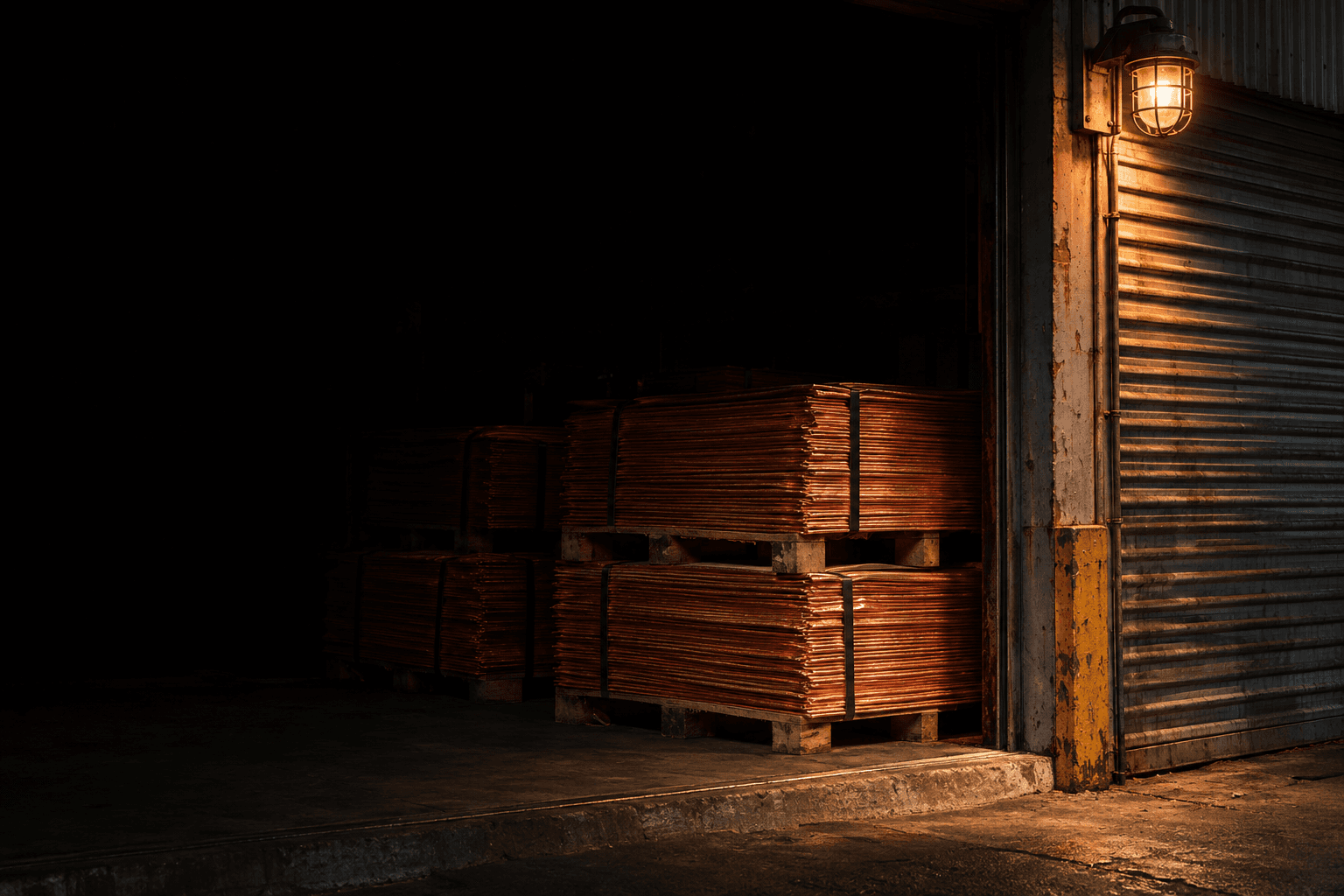
Copper cathodes are sheets of refined metal used as feed for fabricators. The London Metal Exchange's copper specification requires Grade A cathodes of an approved brand for delivery against its contract. So a London quote gives you a reference for industrial metal on exchange terms. It doesn't give a buyer of bars or a bundle of pipe a standing offer at that price.
For a physical purchase, we'd compare the dealer's delivered price with what an actual buyer would bid for the same grade and quantity, net of transport. The difference tells you how much the resale bid would have to rise to cover the round trip before storage costs. That hurdle can make the route unattractive even if you get the direction of the exchange price right.
A COMEX Contract Sets the Pounds and the Month
A futures contract is an agreement to buy or sell a set quantity at a price agreed today for a future delivery date. The CME Group specification we checked on Nov. 22, 2026 lists the standard COMEX copper contract as deliverable. Each contract covers 25,000 pounds. COMEX quotes in U.S. dollars per pound, while London quotes in U.S. dollars per tonne. The delivery dates and units need to match before the two prices tell you much about the difference between the markets.
On that contract size, a hypothetical rise of US$0.10 per pound gives a buyer a US$2,500 gain per contract before trading costs, by our arithmetic. A decline of the same size costs the same amount. The broker requires margin, a deposit against possible losses, rather than the full value of the copper. The gain or loss still applies to the full contract, so a move against you can require more cash before your view has time to play out.
Trading the contract requires a futures account. A buyer who wants price exposure without taking delivery needs to close or roll the position before the broker's applicable cutoff. Rolling means closing one contract and opening a later one. If you intend to hold exposure for months, the prices of those later contracts are part of the trade from the outset.
CPER Seeks to Track a COMEX Futures Index
CPER is a way to hold copper futures exposure through a brokerage account without managing the contracts yourself. Its June 30, 2026 prospectus supplement says the fund invests mainly in the futures selected for the index. The USCF fund page identifies those as COMEX contracts selected by the SummerHaven Copper Index Total Return and says the fund rebalances monthly to reflect index changes. The fund can also use other copper-related instruments and holds collateral, including cash and U.S. government obligations.
The nearest contract in CPER's published November 2026 benchmark basket was for March 2027 delivery. The December 2026 futures quote could move differently from that basket, even before fund expenses. Net asset value per share is the value of the fund's assets less all its liabilities, divided by the number of shares outstanding. The share price you pay may be above or below that value.
The futures curve, meaning the prices across delivery dates, also changes what you earn. When later contracts are more expensive than nearer ones, those deferred prices can fall as delivery approaches even if the cash price is unchanged. The opposite curve can help a holder. The trade at the roll does not itself book the gap between the two contract prices as a loss or gain. What counts is how the contracts you hold move while you own them, along with collateral income and fund costs.
COPX Owns Mining Companies
The Global X Copper Miners ETF (NYSE Arca: COPX) holds shares of mining companies. Its benchmark, Solactive Global Copper Miners Total Return Index, tracks mining equities. The Global X fund page says the fund aims to match the index's price changes and income before fees and expenses. Global X listed 41 holdings as of Nov. 20, 2026.
The basket reduces what any single mine closure or cost overrun can do to your investment compared with owning only that miner. It still leaves you exposed to a sector where costs can rise at several companies at once. The composition also decides how much exposure you get to other metals and currencies. For a Canadian investor buying the U.S. listing, the return measured in Canadian dollars also depends on the exchange rate when valuing the shares.
If you already hold a miner, we'd check its weight in the fund before counting the fund as diversification. Owning a basket alongside a large position in one of its constituents can leave more riding on that company than the number of lines in a brokerage account suggests.
Copper Prices Reach Mining Shares Through Sales and Costs
A higher copper price can widen a miner's margin if the company realizes the increase on the pounds it sells and its costs don't rise by as much. In Washington Blinked on Copper, we traced how the gap between U.S. and London prices could reach Freeport-McMoRan (NYSE: FCX). Freeport's July 23, 2026 results say its U.S. mine sales generally use the monthly average of COMEX settlement prices. A wider gap helps only if that monthly average rises for sales that still have a price to set.
Freeport's Oct. 27, 2026 results forecast fourth-quarter copper sales of 875 million pounds across the company. By our arithmetic, if its realized price on that volume rose by a hypothetical US$0.10 per pound, gross sales value would rise by US$87.5 million. That illustrates sensitivity to a change in the price actually received on all those pounds, separate from a COMEX-only move. Freeport also reported adjustments to earlier concentrate and cathode sales that had been priced provisionally. A company can record a sale before it knows the final price.
The gross sales calculation leaves out costs, taxes and the timing of receipts. Even higher operating cash flow leaves the company with spending on the mines and claims from lenders before shareholders see what can be distributed. Freeport's October release forecast full-year 2026 capital spending of US$4.4 billion. That's a use of cash that the gain on a futures contract doesn't have to fund.
Other metals can change the calculation. Teck Resources (NYSE: TECK) said in its Oct. 28, 2026 results that strong by-product pricing lowered its 2026 guidance for copper net cash unit cost, a non-GAAP measure. A by-product credit offsets reported copper costs with revenue from other metals.
Hudbay Minerals (NYSE: HBM) reported a negative consolidated cash cost of US$0.19 per pound of copper for the September 2026 quarter. Its Nov. 12 results put consolidated sustaining cash cost at US$1.61 a pound for the same quarter. Both are non-GAAP measures net of by-product credits. The negative cash cost alone can't tell you how much cash is available to shareholders.
The Tariff Test Is in the Spread
The proposed U.S. duty on refined copper gives us a way to test which price each investment follows. The White House's July 30, 2025 fact sheet said the measure put a 50% tariff on the copper content of covered semi-finished products and derivatives while excluding cathodes.
Commerce separately recommended a phased universal duty on refined copper. Clause 7 of the July 2025 proclamation directed Commerce to provide a market update by June 30, 2026, so the President “may determine whether” the duty “is warranted.” The first phase contemplated a rate of 15% from Jan. 1, 2027. The second would raise it to 30% from Jan. 1, 2028. The proclamation did not impose either rate.
The spread is the COMEX price minus the London price on comparable delivery dates, expressed in the same currency and unit. At an unchanged London price, a wider U.S. premium means COMEX is higher. If the spread widens because London falls, a COMEX holder needn't make money. For CPER, we'd match London futures prices to the COMEX maturities in the fund's benchmark and use comparable observation times. For a miner, we'd check which sales remain unpriced and whether the benchmark and pricing period in their terms would give the company a higher realized price.
The CME warehouse ledger dated Nov. 20, 2026 shows why we'd pair that spread with inventories. For activity on Nov. 19, 2026, the New Orleans rows show a reclassification of 2,206 short tons. The ledger subtracted that amount from registered stocks and added the same amount to eligible stocks. Registered copper carries a warrant that can be used for futures delivery; eligible copper meets exchange standards but lacks that warrant.
The reclassification removed no copper from the warehouse. The report separately shows 431 short tons withdrawn at New Orleans on the activity date. We separated the two entries in COMEX Copper Stocks Edge Up.
On Jan. 1, 2027, the contemplated start of the first phase, we'll look for any new proclamation. The timetable sets no deadline for a decision. We'll also track warehouse receipts and withdrawals alongside the gap between futures for comparable delivery dates. If Washington rules out a duty and the spread stays wide, we'd look at freight and the metal available for delivery before attributing the remaining gap to policy.
Buying copper exposure means choosing who sets your price.
Seek the truth and be prepared,
Equedia
Sources
- USCF, United States Copper Index Fund Prospectus and Supplement
- London Metal Exchange, LME Copper Contract Specifications
- CME Group, Copper Futures Contract Specifications
- USCF, CPER Fund Overview and Benchmark Components
- Global X, Copper Miners ETF Overview and Fund Details
- Equedia, Washington Blinked on Copper
- Freeport-McMoRan, Second-Quarter and Six-Month Results
- Freeport-McMoRan, Third-Quarter and Nine-Month Results
- Teck Resources, Unaudited Third-Quarter Results
- Hudbay Minerals, Third-Quarter Results
- White House, Copper Import Tariff Fact Sheet
- White House, Adjusting Imports of Copper Into the United States
- CME Group, COMEX Copper Warehouse Stocks Statistics
- Equedia News, COMEX Copper Stocks Edge Up
Disclaimer: This letter is for informational and educational purposes only and does not constitute investment advice. Past predictions and performance are not indicative of future results. Please see our full terms of use and disclaimer at equedia.com.