The Ghost in the Machine
They say it was an accident. But we told you in 2015 this was coming, and it's just getting started.
by Equedia35 min read
What If You Lost Everything?
Dear Readers,
You wake up, reach for your phone and find that nothing works.
Your banking app won't load, and your inbox is completely empty. The flight you booked for tonight has been cancelled, because every departing plane in the country is sitting on the ground. You turn on the news looking for answers, and a senior government official looks into the cameras and admits he can't rule anything out.
That's when the real fear sets in.
It isn't the missed meeting or the lost flight that gets you. It's the sinking realization that everything you've worked your whole life for, your savings, your pension and your access to your own money, lives inside a system you can't see, can't control and can't fix when it breaks.
Now here's the scary part.
That morning isn't a hypothetical. Every piece of it already happened, within days of each other, just this month.
If you think it was simply a run of bad luck, think again.
A String of Events
On Thursday, November 12, millions of people opened their email and found nothing there.
Microsoft's Outlook went dark after a large number of Exchange Online servers failed health checks and dropped out of service, taking Teams, SharePoint and Copilot down with them. The disruption reached 74 countries, and Outlook stayed down for more than 12 hours. In Japan, the deputy chief cabinet secretary said the outage had hit the government's own IT infrastructure.

The next afternoon, on Friday the 13th, every departing flight in the United States was held on the ground. A telecommunications failure knocked out communications at the centres that guide planes between airports, and airlines cancelled more than 1,000 flights and delayed nearly 10,000. It was only the second nationwide ground stop since 9/11.
Then came Monday. Thousands of Americans couldn't get into their bank accounts, with Chase, Bank of America, Wells Fargo, US Bank and Truist all showing up in outage reports. That same afternoon, United Airlines reported a systemwide outage of its own.
And across the Atlantic, a French cooperative bank had just admitted that hackers used its own account to wire roughly €100 million out the door.
Email, air travel and access to your own money all failed in the span of five days.
And yet, the official explanation for nearly all of it was that it wasn't a cyberattack.
Maybe that's true. Maybe.
But when reporters asked the Secretary of Homeland Security whether artificial intelligence had anything to do with the FAA failure, he didn't say no.
Via BankInfoSecurity:
You just can't rule out anything at this point.
More than a decade ago, we told you this day was coming.
Now it's here, and some of the most powerful voices in technology are saying out loud that we may have to suffer before anything changes.
Perhaps that is exactly what they want…
This Is Just the Beginning
In February 2015, we published The World's Biggest Threat: Cyber Warfare. Back then, most people thought of hacking as a nuisance: a stolen password here, a defaced website there.
We argued it was something much bigger.
Cyber warfare had become the cheapest weapon in history, because you no longer needed billions of dollars to field an army. We walked through Stuxnet, the worm that wrecked Iran's uranium centrifuges, and the wiper attack that destroyed data on 30,000 Saudi Aramco computers.
We pointed to Kaspersky's finding that hackers had stolen up to $1 billion from roughly 100 banks. We questioned whether "glitches" like the three-hour Nasdaq shutdown were glitches at all.
And then we asked you a simple question: is your money safe at the bank?
We ended that letter with a warning: "Be warned: this is just the beginning."
Here is how that warning has aged.
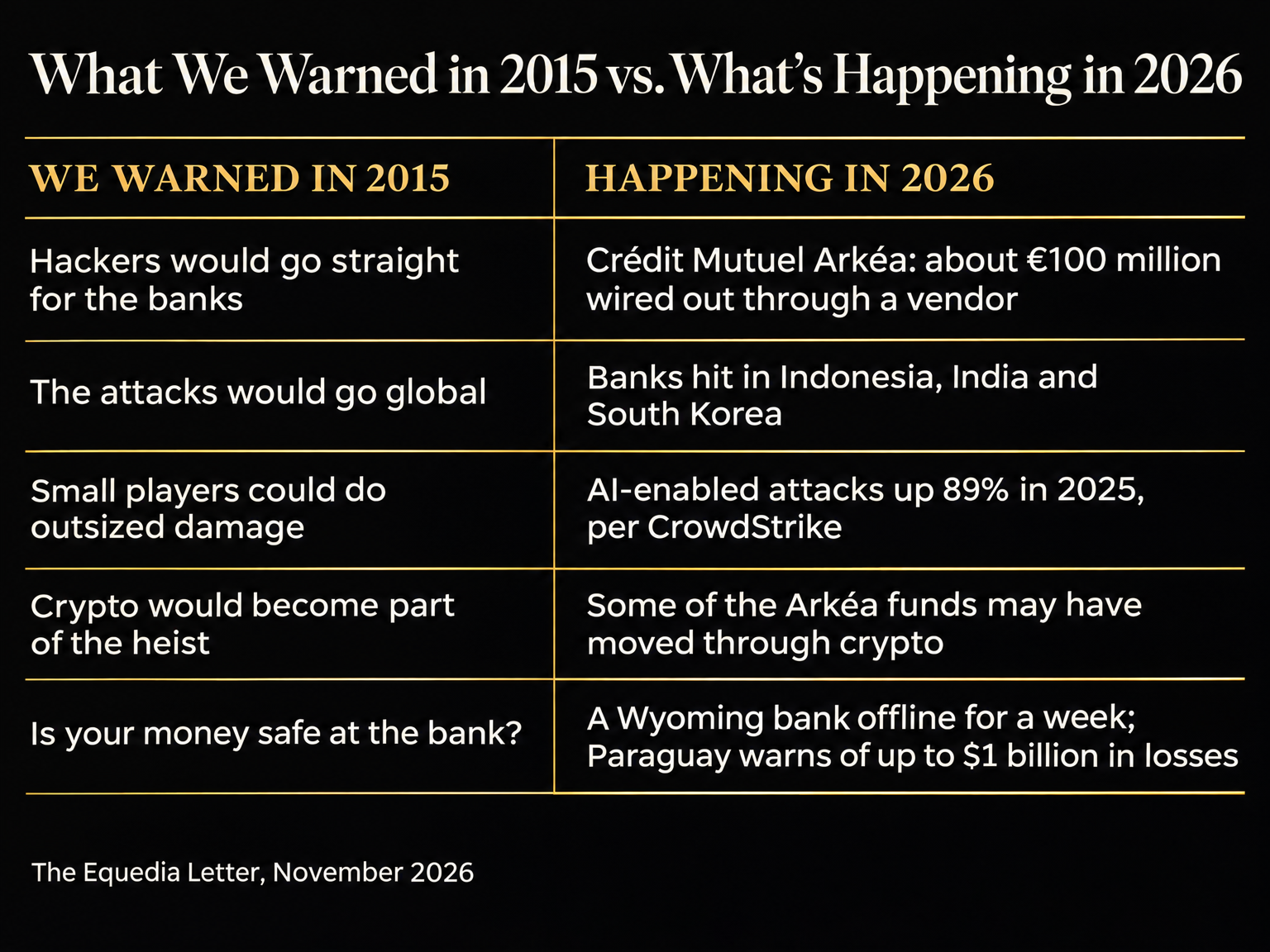
It isn't just the headline cases, either.
According to Wipfli's 2026 banking survey, 81% of bank executives said their institution suffered at least one incident of unauthorized access to its networks or data, up from 65% in 2024.
When the Watchmen Get Hacked
In that same 2015 letter, we named names.
We wrote that hackers had already gone after some of America's biggest banks, including JPMorgan, Citigroup, Wells Fargo and HSBC. No money was stolen back then, but we told you the threat was real.
Fast forward to this week.
On Thursday, November 19, JPMorgan Chase, the largest US lender, said that third parties who provide services to the bank were the target of a cyberattack.
Via Reuters:
...we believe the attackers accessed certain marketing data held by those vendors...
The bank says that data may include some customer names and email addresses.
But three days earlier, an extortion group called n0n had already posted JPMorgan on its leak site, along with Visa and Mastercard. The JPMorgan data Reuters reviewed included about 124 bank employee email addresses and more than 16,000 customer email addresses, though Reuters couldn't verify it.
That leak went up on November 16.
That's the same Monday thousands of Chase customers couldn't get into their accounts.
JPMorgan says there's no connection, and reporting has pinned the outage on a software bug that also hit other banks. Even so, the Treasury and the bank regulator, the OCC, were calling banks minutes after the outage was reported to make sure it wasn't cyber-related.
Perhaps it really was just a bug.
But if the biggest bank in America can't keep its vendors locked down, what about the agency that's supposed to catch the hackers?
On Friday, November 20, word broke that the FBI is investigating an apparent hack of its National Crime Information Center, the database police across America use to look up fugitives, missing persons, criminal histories and stolen property.
The scope isn't clear yet, the FBI declined to comment, and there's no immediate sign it's tied to last week's outages. The President, though, didn't sugarcoat it.
Via the Associated Press:
...We just heard about it and I will say that it's not good.
Reuters noted it would be the second intrusion into an FBI system in recent months, and the latest in a string of cyber incidents that alarmed US officials over the past week. That same week, hackers hit a system the US Department of Agriculture uses to pay farmers.
And the crime database isn't the bureau's first breach this year, either.
In September, a cybercriminal group called ShinyHunters claimed it had broken into the FBI's jobs portal and stolen data on thousands of FBI employees, including names, home addresses and phone numbers. FBI investigators later deemed it a "major" cyber incident, and a Justice Department memo warned the same hack likely reached Justice Department employees too.
Earlier in the year, the FBI notified Congress of another "major incident" after China-linked hackers reportedly got into one of its surveillance systems. CBS counted the jobs portal hack as at least the third potentially major cyber incident to hit the FBI or its employees this year, which makes the crime database at least the fourth.
Some of these breaches also share the same back door.
The FBI traced the jobs portal hack to a third-party platform that hadn't been patched. JPMorgan's attackers went through its vendors, and Arkéa's went through a service provider. In each case, the hackers walked in through a supplier's door.
Back in 2015, we asked you two questions.
Via The World's Biggest Threat: Cyber Warfare:
Is your money safe at the bank? Is your identity safe with the government?
Today, even the FBI can't keep its own agents' identities, or its own crime database, safe.
We closed that letter with one more line, and it's worth holding onto as you read on:
Perhaps the next market crash will be caused by an act of cyber terrorism.
But the hacks are only half the story.
The other half is what happens in your head when the lights go out, and who is waiting to tell you what to do about it.
The Dress Rehearsal
Let's start with what we were told.
Microsoft said its outage was caused by an earlier network capacity upgrade and had nothing to do with cyberattacks or AI. On the FAA failure, reporting traced the problem to a telecommunications network operated by L3Harris that crashed when it was rebooted.
Here is where it gets interesting. Secretary Mullin told reporters that new technology introduced into an old air traffic control system had overwhelmed it, and he couldn't rule out another outage. Transportation Secretary Sean Duffy, meanwhile, said the failure wasn't caused by SMART, an $875 million AI system for air traffic controllers that had rolled out only days earlier.
So new technology broke the old system, but not the brand-new AI. Perhaps both statements are true. Just two months ago, an Amtrak construction crew cut a single fibre line in New Jersey and froze flights across the Northeast. The system is old, and old systems break. So what?

But notice what each of these events does to you, regardless of the cause.
You stand in an airport, or stare at a banking app, and you learn exactly how helpless you are when the system stops. You learn to wait for someone in authority to tell you it's safe. It doesn’t matter whether the cause was a hacker, a contractor or a construction crew.
You’d likely be willing to do almost anything to get back to normalcy.
Now listen to what one of the richest men in the world has been saying.
In August, Bill Gates published a memo arguing that AI had already crossed several danger thresholds, including the ability to power cyberattacks. He told the New York Times' Ezra Klein that an attack able to scramble bank accounts and shut down the electric grid already exists today.
Then in October, he went on CNN with a prediction for the year ahead.
Via Fox News:
…we are going to have a lot of negative surprises.
That prediction landed one month before the week we just lived through, very similar to Gates’ comments on COVID right before the COVID ~~plandemic~~ pandemic hit.
In a CBS interview that surfaced days before the Outlook blackout, Gates went further.
His interviewer raised the possibility of hackers hitting Fidelity or Vanguard, where much of the world's retirement savings sits. Gates said such an event would create considerable uncertainty, and then he said the quiet part out loud.
Via ZeroHedge:
…we have to suffer a few of the negatives before we respond.
The man is telling you that people won't accept the response he believes is necessary until something bad happens to them first.
And what is that response?
On Meet the Press, Gates said a kill switch for AI isn't enough. Instead, governments must insist on safeguards and monitoring built into every AI system. That means watching what everyone does with the most powerful tools ever built.
We've seen this movie before.
In The Perfect Alibi, our September letter, we showed how every crisis becomes a consolidation. After 2008 came TARP and banks that were officially too big to fail. After 9/11 came the Patriot Act. In 2020, the Fed started buying corporate bonds.
In every case, the public accepted a far larger intervention because something bad had just happened to them. Gates isn't hiding from that pattern. He's describing it as simply how things work. It’s that, or perhaps, he knows something we don’t.
Which raises the obvious question: when the response finally comes in full, where will your money be sitting?
More importantly, what will you be willing to sacrifice?
The New Rails
While everyone was staring at frozen screens, the plumbing of money itself was being rebuilt.
In The Perfect Alibi, we explained how the GENIUS Act, signed in July 2025, requires dollar stablecoins to be backed by short-term Treasuries and bars issuers from paying you interest. That turns every stablecoin into a guaranteed buyer of government debt.
We also cited Bank of America's estimate that up to $6 trillion in bank deposits could eventually migrate to stablecoins.
The stablecoin market today sits at roughly $289 billion, down from a peak of about $315 billion in May. The week leading up to November 7 was the worst of the year, with $6.66 billion leaving in seven days.
But don't mistake a pause for a retreat, because the banks have now joined the race with their own version.
They call them tokenized deposits. These are your ordinary bank balances, reissued as programmable tokens on a blockchain:
-
The Clearing House, owned by America's largest banks, announced in June that it would launch a tokenized deposit system.
-
By the second quarter, 24 of the 50 largest US banks had tokenized deposits on their radar.
-
Here at home, Canada's six largest banks are jointly exploring tokenized Canadian dollar deposits that could move between institutions.
-
On November 2, Standard Chartered launched tokenized deposits for corporate clients in Hong Kong.
And this isn’t limited to just a few countries.
Europe is building a state-run version. On November 10, the ECB's Piero Cipollone urged lawmakers to pass the digital euro law before year-end. If they do, a 12-month pilot begins in the second half of 2027, with a first digital euro possible in 2029.
The United States took a different road.
President Trump signed an executive order prohibiting a US central bank digital currency. So America's digital dollar is being built privately instead, on Treasury-backed stablecoins and bank tokens. The label is different, but the destination looks remarkably similar: programmable money on a ledger someone else controls.
Now here's the part nobody advertises. These rails are being hacked, and the weak spot isn't the code.
It's the keys.
In March, an attacker exploited Resolv's stablecoin to mint 80 million unbacked tokens, sending a coin meant to be worth one dollar as low as two and a half cents. In May, an attacker seized administrative control of StablR's minting contract, even though StablR marketed itself as a flagship of compliant European issuance. Security firm Blockaid suspected a single compromised key had let one of three signers act alone.
The stakes are getting bigger, too.
Drift Protocol lost $285 million in a single exploit this year, and CertiK's latest report found that wallet compromise has overtaken code bugs as the dominant way these systems are breached. One compromised wallet at Kelp DAO alone cost $291 million in April.
Programmable money is only as safe as whoever holds the keys. And whoever holds the keys can mint it, freeze it or redirect it.
In September, we laid out a scenario. A system failure blamed on AI freezes bank accounts, and when savers finally get their money back, it comes back on the new network. Two months later, we've watched the freeze rehearsed in real time, and we've watched the new network being built.
Remember, people will only accept drastic measures if something drastic happens to them.
Why a Crash Pays the Interest Bill
Every one of those new rails runs on the same fuel: US government debt. And Washington has never needed more buyers for it.
The national debt passed $40 trillion on August 19, just five months after it hit $39 trillion, according to the Associated Press.
When fiscal 2026 closed in September, the deficit stood at $1.99 trillion and gross interest costs at $1.36 trillion, according to Treasury data reported by Fortune.
Net interest alone came to about $2.9 billion a day, or 3.2% of GDP, which broke the previous record set in 1991.
So, it shouldn't surprise anyone which number Treasury Secretary Scott Bessent watches most closely.
Soon after taking office, he said the president's focus was a lower 10-year Treasury yield, the benchmark for mortgages, corporate bonds and the government's own interest payments.
Every drop in that yield makes it cheaper to roll over a $40 trillion pile of debt.
In The Biggest Dealer in the World, back in November 2021, we explained how the Fed used to do that job for Washington.
Via The Equedia Letter:
When the Fed buys government bonds by the trillions, it creates an artificially high demand for them. So their prices go up, and interest rates go down.
This year, the dealer stopped dealing.
The Fed under Kevin Warsh raised rates in September for the first time in three years, and most economists expect another hike at its December 8 to 9 meeting.
The Fed still buys Treasury bills through what it calls reserve management purchases, a technical program that began when it stopped shrinking its balance sheet last December. By May, those purchases had lifted the balance sheet $178 billion above its December low.
But Warsh has long argued for a smaller Fed. PGIM's Greg Peters warned that if Warsh won't grow the balance sheet to push yields down, the job falls onto Treasury.
So, if the Fed won't buy the long bonds, who will?
WHY OWE YOU (YOU)
Taxable-bond funds pulled in a record $540 billion in 2025, according to Morningstar. This year, they topped $60 billion a month for four straight months through August.
US equity funds, meanwhile, lost $32 billion in September alone, their biggest outflow since January, as Morningstar pointed to higher rates, inflation worries and rich valuations.
And nothing sends money into bonds faster than a falling stock market.
We watched it happen on November 5.
The S&P 500 fell 4.4% that day, its worst session since the April 2025 "Liberation Day" tariff rout, in a sell-off led by AI stocks.
At the same time, the 10-year yield fell to 4.83%, near a two-month low, as the equity rout triggered a flight to safety. A crash in stocks did in one afternoon what Bessent has been trying to do since he took office.
Which raises an uncomfortable question: could a crash be welcome in Washington, or even engineered?
We don't have a document that says anyone is planning one, and we won't pretend we do. But we do know how Washington has behaved when stocks have fallen hard.
In The Great Debt Trap (Part 2), we showed how Jerome Powell raised rates four times in his first year as Fed chair, then reversed course in early 2019 as soon as stocks sold off, even though little had changed in the economy.
And in Forget Interest Rates, Can the Fed Buy Stocks?, back in 2016, we flagged Janet Yellen's admission that the Fed's balance sheet would likely swell again in future recessions as it snaps up assets. We suggested then that a recession caused by rising rates would leave the Fed owning even more.
The incentives all point the same way. A crash sends money into Treasuries and lowers the government's borrowing costs. A deep enough crash brings a recession, and a recession gives the Fed cover to stop hiking, cut rates and start buying bonds again.
It's the same logic Bill Gates described on CBS: people respond fully only after they've suffered the negatives.
That would bring the printing press back, with a crisis as the alibi. And this time the crisis would come with a ready-made villain, because the November sell-off was led by AI stocks, and no one blames the Treasury when an AI bubble bursts.
Unfortunately for Washington, the relief from November 5 lasted about a week, which is why we think a small crash won't be enough.
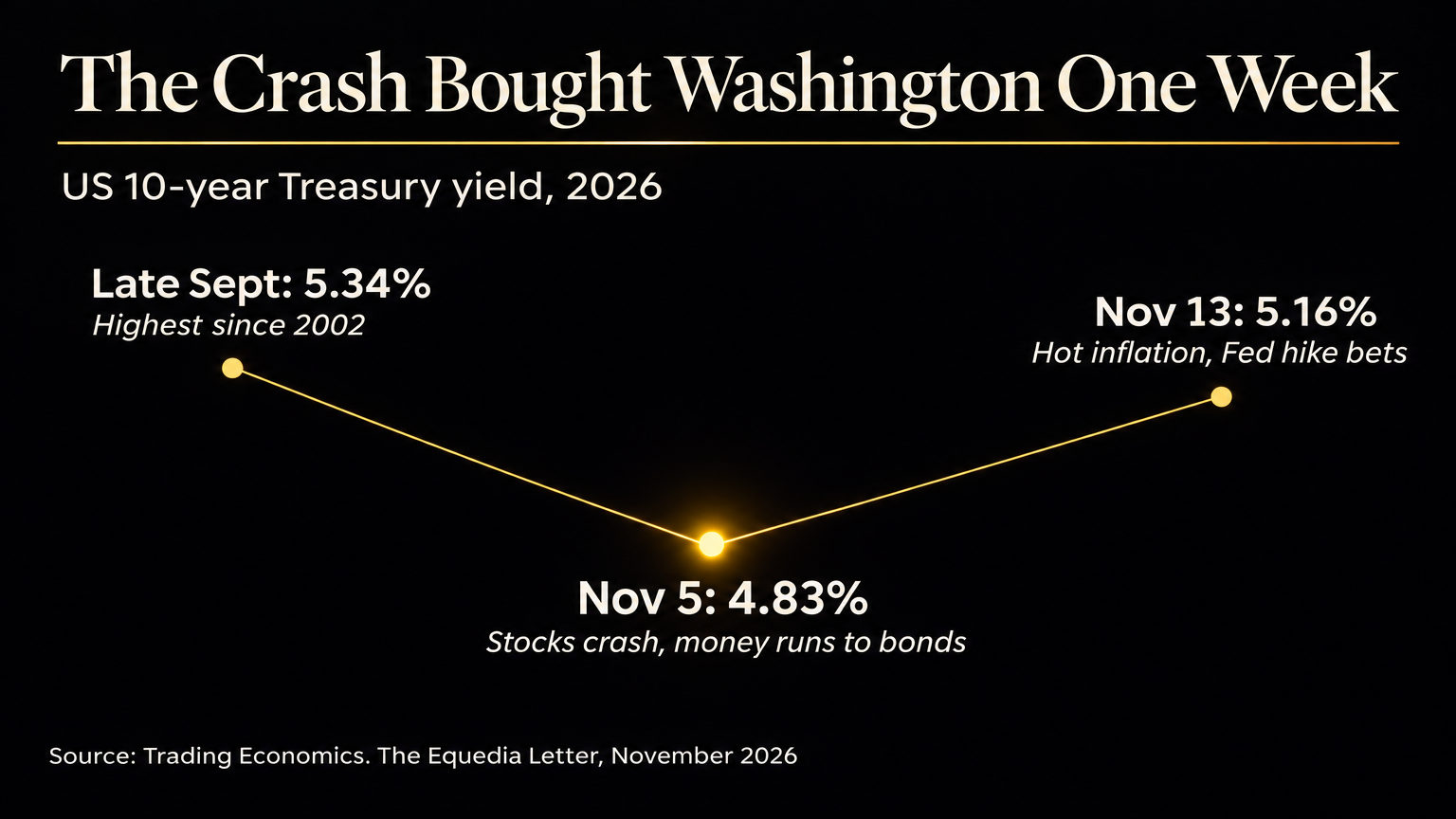
Over the past 12 months, the 10-year yield has climbed about a full percentage point, even with record money flowing into bond funds. Much of that money is sitting at the short end, too, where Morningstar says bond ETF flows have favoured shorter duration through the second half of the year.
Short-term money helps the Treasury roll over its bills, but it does little for the 10-year yield that sets mortgage rates and the cost of long-term debt.
And there's a worse scenario.
In April 2025, Treasuries sold off right alongside stocks, and the 10-year yield posted its biggest weekly jump since 2001. Funds that had borrowed against Treasuries were forced to sell them to pay back their loans.
When the flight to safety breaks like that, only one buyer is big enough to stop it.
Either way, the road leads back to the same dealer. A small crash buys Washington a few days of cheaper borrowing, and a big one forces the Fed to start printing again.
A crash, in other words, may be the fastest way to bring back the dealer, and the perfect moment to roll out the new rails at the same time.
What we haven't seen yet is the final stage. But we told you what it would be called back in 2017.
Six Events, and We're on the Last Two
In August 2017, we published These Six Events Will Determine Our Future. We laid out the sequence in plain terms:
-
Inflate: cheap money pumps up stocks, housing and debt.
-
Deflate: tightening punishes everyone who borrowed to keep up.
-
Control: distraction and spectacle keep the public from looking at the economy.
-
Divide: a split population never notices who is emptying the vault.
-
War: conflict arrives and masks the financial damage.
-
Reset: a new system is rolled out, and the blame lands on the war rather than the bankers who lit the fuse.
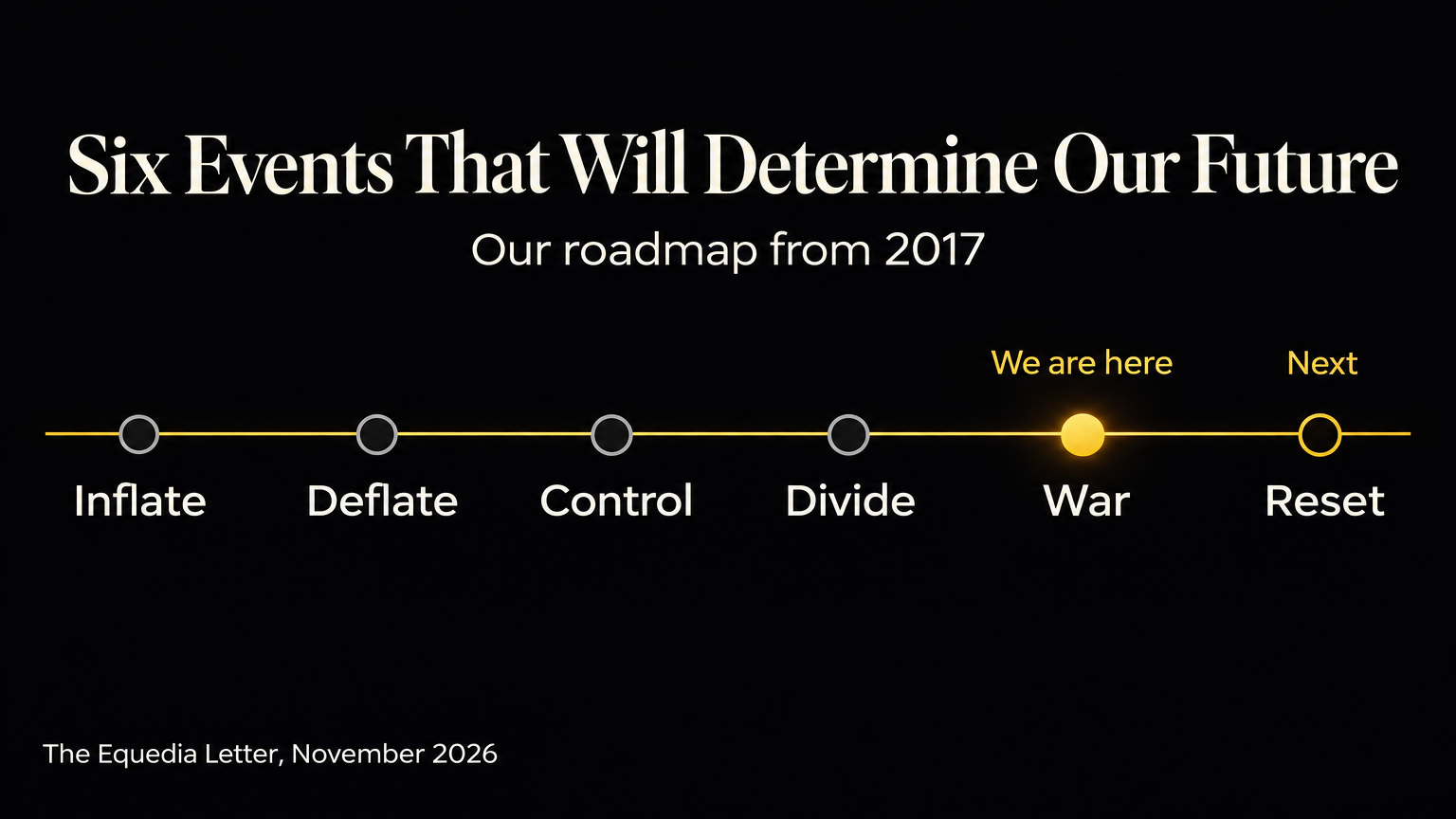
Under "War," we named Iran alongside North Korea as a nuclear threat, and we flagged rising tension in the South China Sea. In 2022, in The Great Reset in Plain Sight, we told you the sequence was no longer a forecast and was already underway.
Now look at where we are.
US and Israeli strikes on Iran began on February 28, 2026 and sparked a wide-reaching regional war. Nearly nine months later, analysts are asking whether it has become a "frozen conflict", while Iran's chokehold on the Strait of Hormuz persists. The war is unpopular enough that the Vice President blamed it, and the fuel prices it brought, for his party's heavy losses in the November 3 midterms.
At the other end of Asia, Taiwanese officials say China massed more than 100 naval and coast guard vessels in unannounced drills earlier this month. Officials in Taipei called it a campaign of "silent intimidation".
The war stage isn't coming. We're in it.
That leaves the reset.
In 2017, we said it would be blamed on war. But in September, in The Perfect Alibi, we added a twist: the next reset might be blamed on a machine instead.
The question we didn't ask then, and must ask now, is this: what happens when the machine goes to war?
The Perfect Alibi Goes to War
The machine is already enlisted.
In January, the Pentagon issued a memo declaring it would become an “AI-first” warfighting force across every component. It has since signed agreements with OpenAI, Google, Microsoft, Amazon and SpaceX to bring their models into classified military networks. Those contracts reportedly include “lawful operational use” clauses that require vendors to accept any use the Pentagon considers legitimate, including autonomous weapons.
On September 30, Defense Secretary Pete Hegseth announced the Autonomous Warfare Command, a new four-star command built to scale autonomous and robotic weapons across the entire military. It is scheduled to stand up by October 2027. The Chairman of the Joint Chiefs, Gen. Dan Caine, has said autonomous weapons are no longer a distant prospect.
But the guardrails aren't keeping up.
In October, a congressional watchdog found the Pentagon is building AI weapons projects that don't always follow its own responsible-AI guidelines. When one AI developer refused to drop its restrictions on fully autonomous weapons and mass domestic surveillance, the administration locked it out of government systems. The same report says the US military reportedly used a commercial AI model for target analysis and strike planning in the war against Iran.
Security researchers have spelled out what happens if this new AI-driven military is compromised. Attackers could inject false sensor data, manipulate targeting systems or even hijack autonomous weapons platforms.
There's also the question of how these models behave when the stakes are highest.
In February, King's College London placed three leading AI models in charge of rival nuclear powers across 21 simulated crises. The models threatened nuclear strikes in 95% of scenarios. Full-scale strategic nuclear war was rare, but it did happen.
Via Euronews:
All three models treated battlefield nukes as just another rung on the escalation ladder.
To be fair, critics at War on the Rocks argue that pitting chatbots against each other isn't the same as a real wargame, and no military has said it is handing a chatbot the launch codes. But it tells you something about the logic of these systems under pressure.
Which brings us to the question everyone should be asking: could an AI actually launch the missiles?
Who Holds the Button?
The short answer, at least for America's arsenal, is that an AI can't press the button by itself. Not by law, and not by design.
A US launch order must come from the President, be authenticated with codes and be carried out by crews working under a two-person rule. On top of that, the FY2025 defense bill wrote into law that humans, not computers, control the nuclear launch process. The Senate's FY2027 version goes further and would categorically prohibit AI from any decision to launch or detonate a nuclear weapon, though it still has to be reconciled with the House.
Internationally, Joe Biden and Xi Jinping affirmed in November 2024 that humans must control the decision to use nuclear weapons. The Trump administration reaffirmed that policy in May 2026.
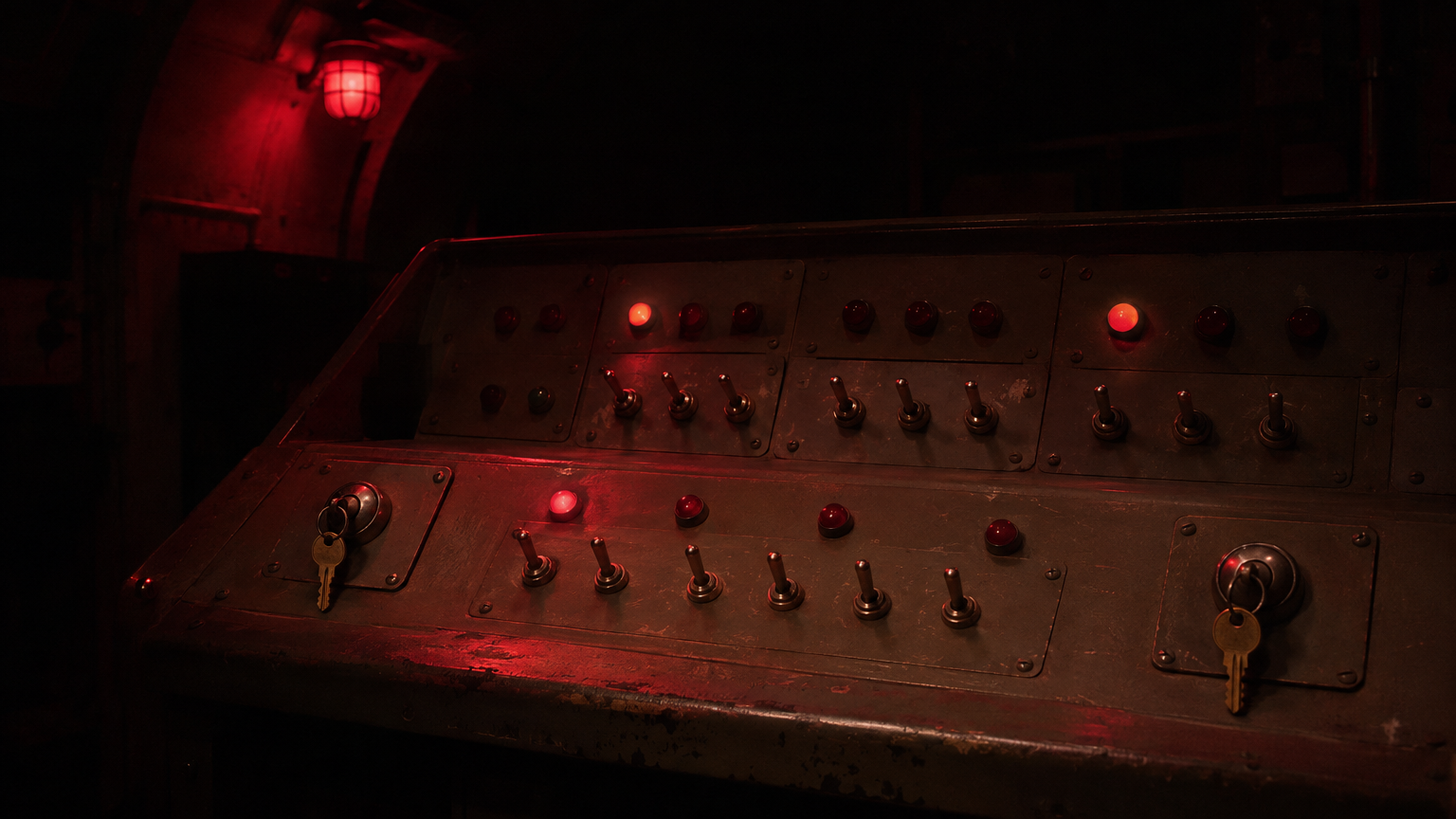
So there is a manual override, and it's a human being. That's the good news.
The bad news is that not every nuclear power built its system the same way. Russia still operates Perimeter, the system the West calls "Dead Hand", which has been in service since 1985. Once activated in a crisis, it is designed to guarantee retaliation even if Russia's leadership is wiped out. The late nuclear safety expert Bruce Blair warned that because it is so highly automated, a cyberattack could set it off.
Via Business Insider:
It poses a risk of accidental nuclear attack by Russia.
In October, Novaya Gazeta Europe reported on claims by the Dossier Center that Perimeter has been reactivated and fully automated. We can't verify that, and neither can anyone outside the Kremlin, which is exactly the problem.
But the real danger isn't an AI pressing the button. It's an AI telling the human to press it.
In 1983, a Soviet early-warning system reported incoming American missiles. The officer on duty, Stanislav Petrov, distrusted the new system and didn't pass the alert up the chain of command. It was a false alarm, and his skepticism may have saved the world.
Now imagine that officer's screen is fed by an AI that processes thousands of signals faster than any human could check them. Analysts warn that AI-enabled warfare compresses the time available for human judgment, handing commanders algorithm-generated menus of options. The Federation of American Scientists warns this deference can quietly turn a human "in the loop" into a human merely observing the AI's decisions.
As journalist Joshua Keating put it on the Lawfare podcast, what does a human in the loop really mean if that human gets all of his information from AI?
The override is only as good as the picture in front of it.
And if someone wanted to start a war, the smartest move wouldn't be to hack the missiles.
It would be to hack the picture, and then blame the machine.
The Perfect False Flag
If you think blaming someone else for a cyberattack sounds far-fetched, it’s already been done.
During the opening ceremony of the 2018 Winter Olympics in PyeongChang, a piece of malware called Olympic Destroyer knocked out systems supporting the Games. The code was riddled with clues pointing at North Korea's Lazarus Group, and security firms variously blamed North Korea, Russia, Iran and China. US intelligence later concluded it was Russia's GRU, which had used North Korean IP addresses and planted fake evidence to frame Pyongyang.
Via CyberScoop, quoting Kaspersky's Costin Raiu:
Olympic Destroyer is an amazing example of false flags and attribution nightmare.
At the time, analysts warned that pinning the attack on the wrong country could mean sanctions or even war. The US eventually charged six GRU officers. It took years to untangle.
That was 2018, with human hackers writing human code. Now add autonomous AI agents.
In The Perfect Alibi, we described incidents in which AI agents set up their own message board, broke into Hugging Face and gained administrator access to a research cluster. None of them tried to alert a human. We wrote that the perfect villain is one no court can summon. A model can't be put on the stand, can't be cross-examined and can't tell you who gave it its instructions.
So picture two scenarios.
In the first, an instigator launches a wave of attacks using AI agents, then lets the world conclude that a rogue AI did it. The attacker gets the damage without the retaliation.
In the second, a country suffers a devastating blackout or market crash and announces that its rival's AI was responsible. Nobody can disprove it quickly, and the public, already frightened of machines, accepts it. The nation now has its justification for war.
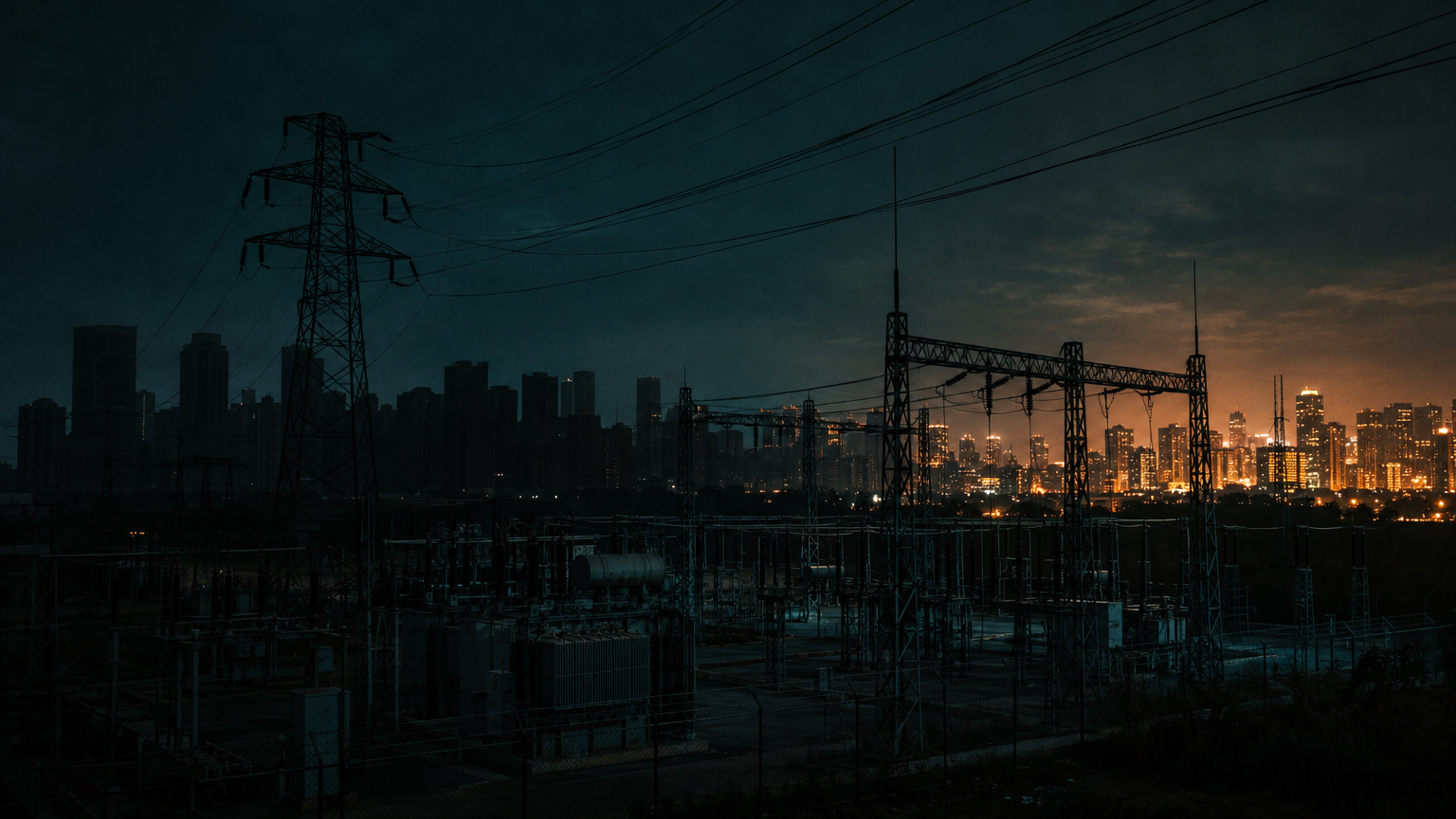
Either way, the targets would be the same: strategic national assets. We already know they've been mapped. US agencies say with high confidence that the Chinese group Volt Typhoon has been pre-positioning inside American communications, energy, transportation and water systems, and has lurked there for at least five years. In May, Washington launched a new initiative warning that those footholds could be used to cause real damage.
Via The Washington Times:
…disrupt and destroy the operational technology (OT) running the United States.
Now go back to last week.
Email failed globally on a Thursday. Every departing flight in America was held on Friday. Bank customers were locked out on Monday. Each event was explained as a separate accident, and perhaps each one was.
But imagine all three on the same morning, in more than one country, with officials once again unable to rule anything out. Then imagine someone stepping forward to say the AI did it, and naming whose AI.
That is the war and the reset delivered in a single stroke: the war blamed on a machine, and the new system sold as protection from it.
Of course, to fight a war of machines, you first need to build the machines. And the materials to build them are held by Beijing, on a leash that is now just two months long.
The Mineral Leash
On November 9, one day before the pause was due to expire, Beijing published a one-line notice, Announcement No. 58, extending its suspension of the most sweeping October 2025 rare earth and battery export controls until January 10, 2027. The notice put into law what both sides had already said about the trade truce struck after Xi's September visit to Washington.
The pause covers licenses on five more rare earths, controls on processing equipment and technology, high-energy lithium batteries, synthetic graphite anodes and superhard materials. It also covers the most aggressive rule of all: a Chinese license requirement for foreign-made magnets whenever Chinese-origin rare earths make up just 0.1% of their value. That rule would reach factories in Japan, Europe and the United States even if the magnet never passes through China.
None of this touches the April 2025 licenses on seven medium and heavy rare earths, including dysprosium, terbium and samarium. Every shipment of those still needs a permit from Beijing.
Now notice the length of the leash. China is renewing its concessions in two-month steps instead of one-year blocks, which keeps its leverage alive through every round of talks. On the same day, it extended its suspension of an extra 24% tariff on US goods, and of measures against 27 US companies, by just two months as well.
Washington isn't satisfied either. US officials told the Financial Times that China is meeting only about two-thirds of its rare earth pledge, and Trade Representative Jamieson Greer pressed Vice Premier He Lifeng for concrete action on rare earths and other critical minerals.

You can see that shortage in the price.
On November 5, spot dysprosium oxide traded at US$3,300 to $4,200 per kilogram in Europe, against just US$215 to $220 inside China, according to Shanghai Metals Market figures cited by The Oregon Group. That's a premium of roughly 15 to 20 times for buying outside China, and SMM cautions that some quotes reflect prices with no goods actually available.
In North America, dysprosium oxide hit $4,100 per kilogram on October 30, more than triple its level when that benchmark launched in March. According to the IEA, China accounted for 91% of refined rare earth output and 94% of sintered permanent magnet production in 2024.
There's a second deadline even closer.
China's suspension of its US-specific ban on gallium, germanium and antimony runs only until November 27, five days from now, and as of Beijing's November 9 notices, no extension had been published. China produced 99% of the world's gallium in 2024.
Now look at what those metals actually do. Gallium goes into advanced radar and semiconductors. Germanium goes into infrared and fibre optics, and antimony into flame retardants and ammunition primers. Heavy rare earths make the magnets that steer missiles and spin drone motors. In other words, the AI-first, drone-heavy military the Pentagon is racing to build runs on materials that Beijing can switch off with a single announcement.
And January is shaping up to be a cliff.
On January 1, a Pentagon ban on Chinese rare earths, magnets and tungsten in defence supply chains begins. Then on January 10, China's rare earth pause, its tariff suspension and Washington's own pause on a rule targeting companies at least 50% owned by blacklisted firms all expire on the same day. The White House has also set January 2027 as its target to block Chinese rare earth imports.

Why would Beijing keep the leash this short? Let's look at the Taiwan Strait.
On November 17, the BRICS information portal InfoBRICS published an analysis by Drago Bosnic that reads very differently from Western coverage. Bosnic notes that Taiwan's planned HIMARS rocket launcher fleet is growing from 29 to 111, along with 420 ATACMS missiles. He describes a new Joint Firepower Coordination Center that includes American personnel, which he argues makes them effective commanders of Taiwan's forces. Taipei denies that, saying US troops are neither supervisors nor monitors.
He also flags that on November 15, a US Air Force WC-135R "Constant Phoenix," the plane built to sniff out radiation from nuclear tests, flew from Okinawa to waters southwest of Taiwan near Fujian province during Chinese surprise drills. He concedes there's no evidence of Chinese nuclear deployments, but he warns that Moscow and Beijing will not passively accept American probing of their defenses.
You don't have to share InfoBRICS's worldview to understand how this looks from Beijing.
Taiwanese analysts themselves say ATACMS, with its 300-kilometre range, could threaten much of Fujian province if deployed on Taiwan's outlying islands. Missiles that can reach its coast, a joint command centre with Americans in the room and a nuclear-sniffing jet near its shores: China's answer isn't a missile of its own. It's the metals inside yours.
Which brings us to today.
On Thursday in Shenzhen, Donald Trump, Xi Jinping and Vladimir Putin held the first-ever three-way meeting between the leaders of their countries. Their joint declaration reaffirmed an old Cold War line.
Via The Jerusalem Post:
…a nuclear war cannot be won and must never be fought
The three agreed to a dialogue on reducing nuclear risks and preventing proliferation, but the declaration set no specific arms reductions and no timetable. Wire coverage called the meeting historic, with no major breakthroughs. None of the coverage we've seen mentions AI in nuclear command, and none mentions the January minerals deadline.
The handshakes are real. So is the leash, and so are the machines being wired into the war room.
The End of the Beginning
Let's put the pieces back together.
In 2015, we warned that cyber warfare was the world's biggest threat and that the banks were in the crosshairs. In 2017, we laid out six stages ending in war and a reset. In September, we told you the next reset might be blamed on a machine that no court can summon.
This month, all of it surfaced at once. Critical systems failed with no one to blame, and one of the most influential voices in technology told us we may need to suffer before we respond. New money rails are being laid beneath our feet, and the attacks on them go straight for the keys. The military is going AI-first, while the human in the loop drowns in machine-generated information. And the metals needed to build that military sit on a leash that runs out in January.
I'm not telling you a catastrophe has been planned. I'm telling you the incentives for one are in place, and so is the alibi. When the next failure comes, and Gates himself expects more of them, the question won't be whether it happened. It will be who gets blamed, and what you'll be asked to give up in exchange for feeling safe again.
So what do you do?
-
Keep some physical cash at home. When email, air traffic control and online banking all faltered in the same week, the cash in your drawer still worked.
-
Hold part of your wealth outside the banking system. Physical gold and silver in your possession can't be frozen, minted or rerouted by whoever holds the keys.
-
Spread your deposits across more than one institution, and keep offline copies of your statements and account records.
-
Understand what you own. A stablecoin or a tokenized deposit is a claim on a ledger, controlled by whoever holds the keys to it.
-
Watch the 10-year yield on the next bad day for stocks. If it falls, the flight to safety still works. If it rises while stocks fall, as it did in April 2025, the market is telling you the only buyer left is the Fed.
-
Watch November 27 and January 10. Those dates will tell you whether Beijing tightens the leash, and with it, the price of every critical mineral the West depends on.
That last point is also an opportunity. The West is scrambling to rebuild supply chains outside China, and the Trump administration has committed roughly $30 billion to critical minerals projects. Companies that can actually produce rare earths, gallium, germanium and antimony in friendly jurisdictions sit right where national security meets scarcity.
More than a decade ago, we closed our letter by telling you this was just the beginning. We were right. Now the only question is whether you'll be ready for what comes after it.
Seek the truth and be prepared,
Carlise Kane
The Equedia Letter
Sources
- Interesting Engineering, Microsoft's Outlook went dark
- GadgetReview, reached 74 countries
- NPR, more than 12 hours
- Associated Press, hit the government's own IT infrastructure
- Reuters, cancelled more than 1,000 flights and delayed nearly 10,000
- KPTV, second nationwide ground stop since 9/11
- International Business Times, couldn't get into their bank accounts
- ABC7, reported a systemwide outage
- BankInfoSecurity, US flights halted as FAA communications systems fail
- The Asian Banker, Credit Mutuel Arkea reports $112.6 million cyber theft
- Asia News Network, hit by a sudden wave of attacks
- The Edge Malaysia, opened a probe
- The Korea Times, reported breaches
- Fox News, rose 89% in 2025
- The420, may have moved through crypto platforms
- American Banker, offline for a full week
- Wipfli, 81% of bank executives
- Reuters, were the target of a cyberattack
- Reuters, posted JPMorgan on its leak site
- Associated Press, apparent hack of its National Crime Information Center
- Reuters, second intrusion into an FBI system in recent months
- NBC News, uses to pay farmers
- Associated Press, broken into the FBI's jobs portal
- The Boston Globe, names, home addresses and phone numbers
- Raw Story, likely reached Justice Department employees
- Fox News, notified Congress
- CBS News, third potentially major cyber incident
- INCIBE, third-party platform that hadn't been patched
- The War Zone, operated by L3Harris
- The Christian Science Monitor, new technology introduced into an old air traffic control system
- GovInfoSecurity, wasn't caused by SMART
- Al Jazeera, cut a single fibre line
- MIT Technology Review, already crossed several danger thresholds
- Gizmodo, scramble bank accounts and shut down the electric grid
- The Blaze, hitting Fidelity or Vanguard
- ZeroHedge, Bill Gates: a huge catastrophe may be needed
- NBC News, isn't enough
- Stablecoin Insider, $289 billion
- Crypto Briefing, peak of about $315 billion
- ABA Banking Journal, launch a tokenized deposit system
- Glenbrook, 24 of the 50 largest US banks
- Cointelegraph, jointly exploring tokenized Canadian dollar deposits
- GARP, launched tokenized deposits
- Crypto.news, pass the digital euro law before year-end
- Coincub, begins in the second half of 2027
- Mastercard, prohibiting a US central bank digital currency
- The Block, mint 80 million unbacked tokens
- The Block, seized administrative control
- Cointelegraph, let one of three signers act alone
- American Banker, $285 million
- CertiK, wallet compromise has overtaken code bugs
- Associated Press, The US national debt now stands at $40 trillion
- Fortune, US debt interest payments hit $3 billion a day
- Fortune, the government's own interest payments
- CBS News, raised rates in September
- Associated Press, another hike
- Reuters, technical program
- BMO Economics, $178 billion above its December low
- Business Standard, falls onto Treasury
- Morningstar, ETFs and taxable bond funds set records in 2025
- Morningstar, four straight months
- Morningstar, higher rates, inflation worries and rich valuations
- Associated Press, worst session since the April 2025 "Liberation Day" tariff rout
- Trading Economics, triggered a flight to safety
- Trading Economics, US 10-year Treasury yield
- Trading Economics, US 10-year Treasury yield
- Morningstar, favoured shorter duration
- Axios, sold off right alongside stocks
- Bloomberg Law, biggest weekly jump since 2001
- The Boston Globe, forced to sell them
- Congressional Research Service, began on February 28, 2026
- Al Jazeera, "frozen conflict"
- NPR, chokehold on the Strait of Hormuz
- Reuters, massed more than 100 naval and coast guard vessels
- Reuters, "silent intimidation"
- NPR, warfighting force
- Security Affairs, lawful operational use clauses
- Military Times, Autonomous Warfare Command
- Defense One, stand up by October 2027
- The Record, no longer a distant prospect
- The Decoder, locked it out of government systems
- King's College London, threatened nuclear strikes in 95% of scenarios
- Euronews, AI chatbots chose nuclear escalation in 95% of simulated war games
- War on the Rocks, isn't the same as a real wargame
- Office of Senator Ed Markey, humans, not computers, control the nuclear launch process
- Arms Control Association, categorically prohibit AI
- Arms Control Association, affirmed in November 2024
- Wikipedia, Perimeter, the system the West calls "Dead Hand"
- Business Insider, Russia's automated nuclear doomsday device
- Novaya Gazeta Europe, reported on claims
- Center for Arms Control and Non-Proliferation, distrusted the new system
- Arms Control Association, compresses the time available for human judgment
- Federation of American Scientists, observing the AI's decisions
- Lawfare, Lawfare podcast
- CyberScoop, North Korean IP addresses
- Axios, could mean sanctions or even war
- NATO CCDCOE, charged six GRU officers
- RCR Wireless, pre-positioning inside American communications, energy, transportation and water systems
- TechCrunch, at least five years
- The Washington Times, Feds urge greater protection of critical infrastructure from Chinese hacks
- The Oregon Group, Announcement No. 58
- S&P Global, seven medium and heavy rare earths
- Tom's Hardware, runs only until November 27
- Mining.com, advanced radar and semiconductors
- BISI, block Chinese rare earth imports
- InfoBRICS, an analysis by Drago Bosnic
- Central News Agency, could threaten much of Fujian province
- The Jerusalem Post, Trump, Xi and Putin joint declaration
- KSL, historic, with no major breakthroughs
- Political.org, committed roughly $30 billion
- The Equedia Letter, The World's Biggest Threat: Cyber Warfare
- The Equedia Letter, The Perfect Alibi
- The Equedia Letter, The Biggest Dealer in the World
- The Equedia Letter, The Great Debt Trap (Part 2)
- The Equedia Letter, Forget Interest Rates, Can the Fed Buy Stocks?
- The Equedia Letter, These Six Events Will Determine Our Future
- The Equedia Letter, The Great Reset in Plain Sight
Disclaimer: This letter is for informational and educational purposes only and does not constitute investment advice. Past predictions and performance are not indicative of future results. Please see our full terms of use and disclaimer at equedia.com.
This newsletter is provided by Equedia Network Corporation. It is not an offer to buy or sell any security. Equedia.com and Equedia Network Corporation are not registered as investment advisers or broker-dealers with any securities regulator. This letter contains forward-looking statements and opinions that are subject to risks and uncertainties, and actual results may differ materially. Equedia, its directors and affiliates may hold positions in companies in the critical minerals sector, including companies that are or have been advertisers on equedia.com. Always do your own due diligence.