SpaceX Stock: Why the Unlocks Are a Buying Opportunity
SpaceX is back near its $135 IPO price as insider shares unlock. Rapid growth, rising AI revenue and a staggered release calendar may give patient investors an entry point.
by Equedia6 min read
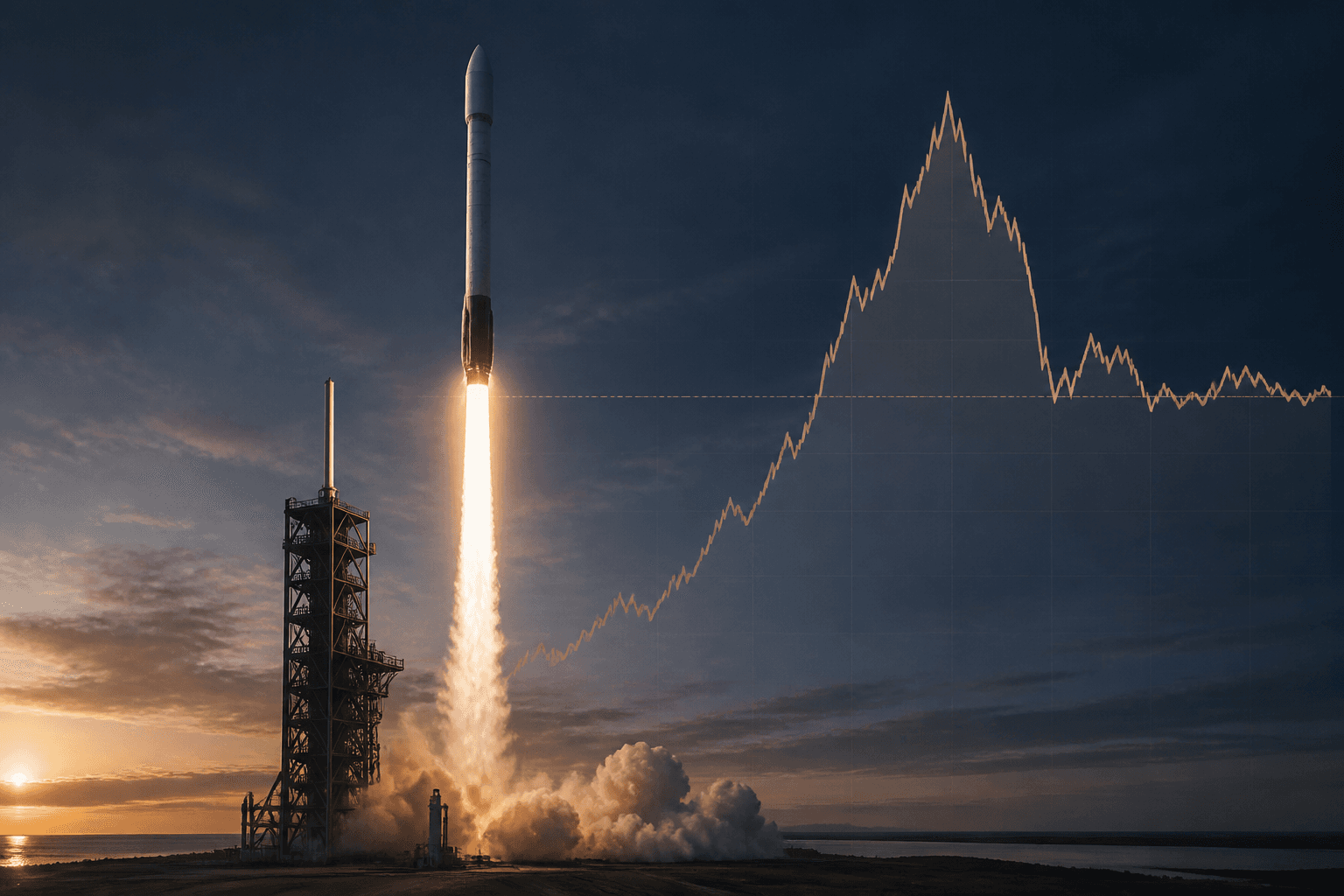
SpaceX stock has returned to where its public-market journey began—and that may be exactly where patient investors should pay attention.
On August 20, another 319 million shares held by early employees and investors became eligible to trade. SpaceX (Nasdaq: SPCX) fell roughly 4% to $134, slipping just below its $135 IPO price.
At $134 a share, those 319 million shares represent about $42.7 billion of stock. That looks ugly in isolation. It looks more interesting when placed beside the company’s operating growth, pre-IPO valuation history and carefully staged share-release calendar.
The key point is simple: an unlock makes shares eligible for sale. It does not force anyone to sell. The temporary increase in supply can pressure the stock even when the underlying business remains intact.
For investors who missed the IPO, those pressure points may be the opportunity.
From $135 to $225—and Back Again
SpaceX priced its IPO at $135 a share and began trading on June 12, 2026. The stock opened at $150, closed its first session at $160.95 and reached an intraday high of $225.64 on June 16.
At the peak, investors were paying almost 67% more than the IPO price just two trading days after the debut. Scarcity played a major role. Only a small portion of SpaceX’s roughly 13 billion shares could trade, while demand for the largest IPO in history was enormous.
Then reality arrived.
The stock fell to $108.27 in early August, more than 50% below its peak and almost 20% under the offering price. It later rebounded above $135, only to fall back to $134 as today’s 319 million-share release reached the market.
Measured from the June high, SpaceX is down roughly 41%. Measured from the early-August low, it is still up almost 24%. From the IPO price, it is effectively flat.
That is not a broken company. It is price discovery colliding with an unusual capital structure.
The Business Is Growing—But It Is Spending Aggressively
SpaceX’s first quarterly report as a public company showed why the stock can attract both true believers and skeptics.
Second-quarter revenue reached $7.81 billion, up 92% from $4.07 billion a year earlier and well ahead of Wall Street’s expectations. The company reported:
- $4.29 billion of connectivity revenue, mainly Starlink
- $2.56 billion of AI revenue
- $962 million from its space segment
- A net loss of $541 million, improved from a $1.0 billion loss a year earlier
- $100 billion in cash, cash equivalents and marketable securities at quarter-end
Starlink remains the economic engine. Connectivity operating income rose 79% to $1.66 billion, while subscribers doubled year over year to 12 million.
The concern is capital intensity. SpaceX spent $18.37 billion on capital expenditures during the quarter, including $15.83 billion in the AI segment. First-half capital spending reached $28.48 billion.
Musk recently told employees that he expects AI revenue to exceed all other SpaceX revenue as soon as September, which would make AI the company’s largest revenue source.
In other words, SpaceX is growing quickly, but it is also attempting to fund rockets, satellites, broadband, artificial intelligence and compute infrastructure at the same time. The company has the IPO cash to do it. Investors still need proof that those investments will earn attractive returns.
That tension explains much of the volatility. Revenue is accelerating, Starlink is profitable and the long-term ambition is enormous. But the cash requirements are enormous too.
We outlined the strategic logic behind the combined space, connectivity and AI platform in The Trillion-Dollar Plan. The public market is now deciding what that plan is worth quarter by quarter.
Today’s Unlock Is Only One Step
Most IPOs use a single 180-day lockup. SpaceX created a staggered release designed to prevent billions of shares from hitting the market at once.
The final prospectus divides the selling restrictions into timed and earnings-linked tranches. The important dates are:
- August 6: Up to 911.5 million shares became eligible after second-quarter earnings. The stock rose roughly 6% that day and gained about 35% over the following five sessions.
- August 20: Up to 319 million shares became eligible—the release pressuring the stock today.
- September 9: Up to another 319 million shares.
- September 24: Up to approximately 328 million shares.
- October 9: Up to approximately 328 million shares.
- October 24: Up to approximately 328 million shares.
- After third-quarter earnings: Roughly 1.3 billion shares, the largest remaining 2026 earnings-linked tranche.
- December 8: The main 180-day restriction expires. The remaining block may approach 798 million shares because a conditional 456 million-share release did not trigger in August.
- 2027: Additional extended-lockup tranches become eligible, while Elon Musk’s roughly 6.42 billion shares remain restricted until June 2027.
These are maximum eligible amounts, not scheduled sales. Some employees and early investors will take profits. Others may hold. The market’s job is to determine how much real selling emerges at each stage.
The August 6 release gave us some clues. More than 911 million shares became eligible—almost three times today’s tranche—and yet the stock rallied. Part of that reaction may reflect market plumbing rather than a simple decision to hold: some shareholders need time to transfer newly eligible shares from a stock-plan administrator or transfer agent into a brokerage account before they can sell. Sophisticated holders may also have hedged beforehand—where their lockup agreements permit—by shorting publicly traded shares, then using their unlocked stock to close the borrowed position. In that case, some economic selling occurs before the unlock rather than on the release date itself. None of this proves that every potential seller chose to hold, but it does show that feared supply can be absorbed when buyers believe the price is attractive.
Investors should expect volatility around every date on the calendar. They should not automatically confuse that volatility with deteriorating fundamentals.
What the Last Private Transaction Tells Us
Before the IPO, SpaceX’s last major conventional private-market liquidity event was a December 2025 secondary sale.
The company approved purchases of up to $2.56 billion from eligible shareholders at $421 a share, implying an $800 billion valuation. Importantly, this was primarily a secondary transaction that gave insiders liquidity—not a standard primary financing in which all proceeds went to SpaceX. The terms were detailed in a shareholder letter reviewed by Reuters.
The valuation climbed again in February 2026 when SpaceX acquired xAI in a share exchange. That transaction valued standalone SpaceX at $1 trillion and xAI at $250 billion, producing a $1.25 trillion combined valuation. The referenced SpaceX price rose from $421 to $526.59 because the standalone company’s valuation increased from $800 billion to $1 trillion—roughly 25%—while xAI shareholders received SpaceX equity rather than cash.
The per-share figures need one more adjustment. On May 4, SpaceX completed a five-for-one stock split: every old share became five new shares, reducing the quoted price without changing anyone’s total ownership value. On that basis, the December secondary price becomes $84.20 per share and the merger reference price becomes about $105.32.
Then came the IPO. SpaceX sold 555.6 million post-split shares at $135, raising about $75 billion in gross proceeds and implying an equity value near $1.77 trillion. The proper per-share comparison is therefore $84.20 in the December secondary, $105.32 in the February merger and $135 in the June IPO—not the unadjusted $421 and $526.59 figures.
That sequence matters:
- December 2025 private secondary valuation: $800 billion
- February 2026 SpaceX valuation in the xAI transaction: $1 trillion
- February 2026 combined SpaceX-xAI valuation: $1.25 trillion
- June 2026 IPO valuation: approximately $1.77 trillion
- Current valuation near $134 a share: roughly $1.75 trillion
The public market therefore still values SpaceX far above its last private secondary sale. But it also gives the company roughly $75 billion of fresh IPO capital, daily liquidity and direct access to public debt and equity markets.
This is no longer the same company that was valued at $800 billion. It includes xAI, holds substantially more cash and has reported 92% quarterly revenue growth. The higher valuation is not automatically irrational—but it leaves little room for execution mistakes.
Our View: Use the Unlocks, Don’t Fear Them
SpaceX is not cheap in the traditional sense. The company is spending tens of billions of dollars, its AI strategy remains unproven, and the coming releases will steadily remove the scarcity premium that helped push the stock above $225.
Those are real risks.
But the long-term assets are also real: reusable launch capability, Starlink’s recurring revenue, 12 million subscribers, major government relationships, valuable spectrum, a growing AI business and a balance sheet funded by the largest IPO ever completed.
We believe pullbacks caused primarily by share unlocks should be treated as opportunities rather than warnings. A drop below the $135 IPO price is an especially useful signal because it lets public investors buy near—or below—the level paid in the offering, after the company has already demonstrated a major revenue beat.
That does not mean buying everything at once, as the calendar argues for patience. Investors who believe in the long-term fundamentals of Space X should scale into a position around the September, October, post-earnings and December releases instead of chasing rallies between them.
SpaceX will remain volatile as billions of shares move from locked to tradable and given the current valuation, there will surely be some sellers taking profits.
However, our conclusion is direct: any meaningful pullback deserves attention, and weakness below the IPO price should be viewed as a buying signal for investors willing to own SpaceX through the next several years—not the next several trading sessions.