German Investment in the US Collapses as Tariff Risk Bites
German companies cut direct investment in the United States to €4.3 billion in the first half of 2026. The headline points to a sharp retreat, but the underlying data reveal a more precise story: established operations remain committed while new capital waits for stable trade rules.
by Equedia6 min read
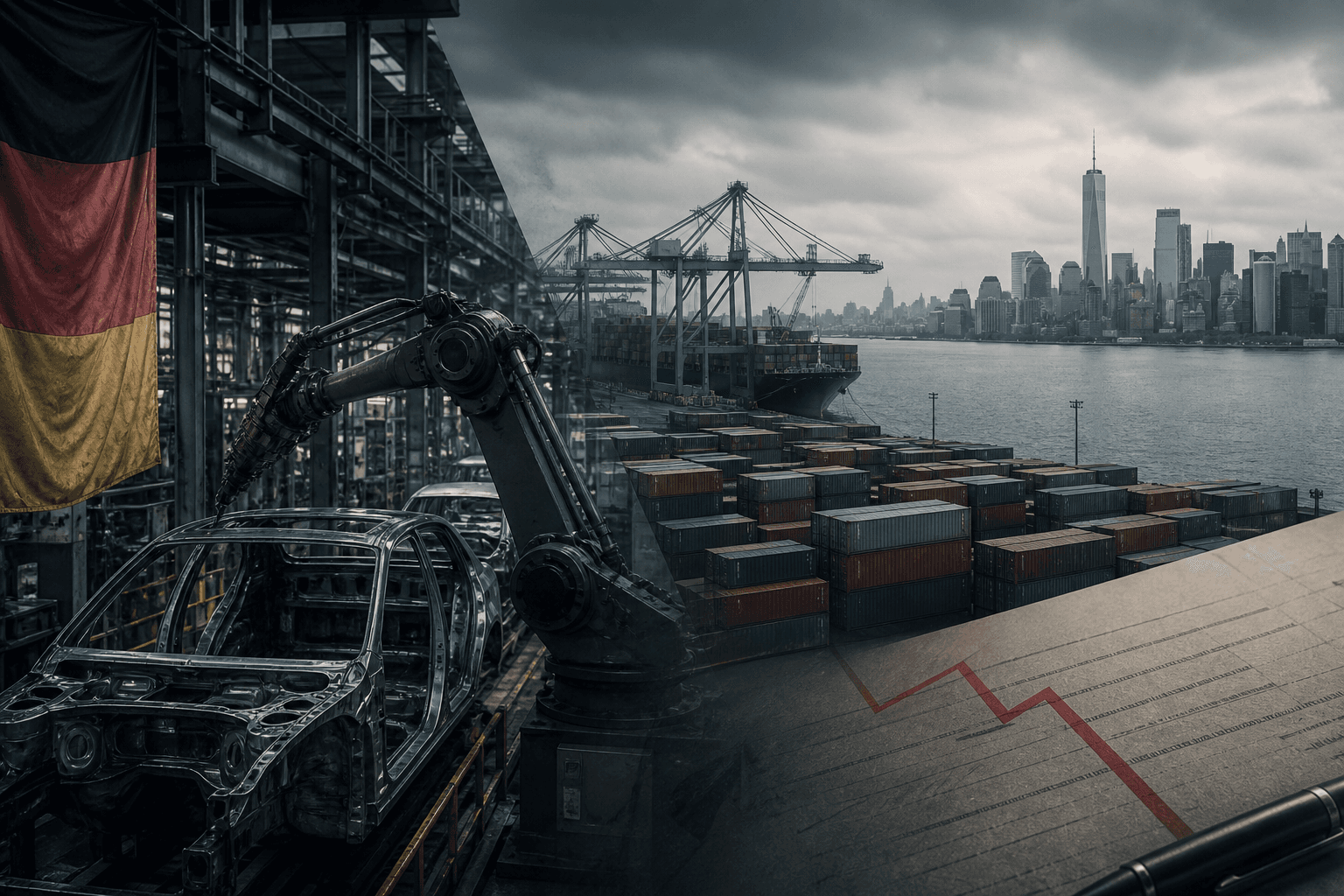
German investment in the United States fell to €4.3 billion in the first half of 2026, its lowest level in three years. That is a major warning for the world’s largest bilateral trade and investment relationship, although one widely repeated comparison needs precision: the decline was nearly two-thirds from the first half of 2025, while the almost 80% drop is measured against the first half of 2024.
That distinction does not weaken the story; it clarifies it. German companies are not abandoning the American market, but they are becoming far less willing to commit fresh equity while U.S. tariff policy remains difficult to forecast.
German investment in the US fell sharply
Calculations by the German Economic Institute, or IW, based on Bundesbank data show that German direct investment in the U.S. fell from €12.3 billion in the first half of 2025 to €4.3 billion in the same period of 2026. First-half investment had reached €21.3 billion in 2024. In the five years before the COVID-19 pandemic, German companies invested an average of €15.8 billion during the first half, making the 2026 figure less than one-third of that benchmark.
The pandemic years require caution because several were distorted by shutdowns, financing shifts and net capital withdrawals. Even with that caveat, the direction since Donald Trump returned to the White House in January 2025 is difficult to ignore. “This continues the downward trend that has been evident since the start of Donald Trump’s second term,” IW researcher Samina Sultan told Reuters.
The immediate explanation is policy uncertainty. The Trump administration has used actual and threatened import tariffs to extract concessions from trading partners. For a company considering a multibillion-dollar factory, distribution centre or acquisition, the tariff rate matters, but the durability of that rate matters more.
This is a capital strike, not a corporate exodus
Foreign direct investment is not one clean measure of new factories. It generally includes three components: equity capital, reinvested earnings and debt transactions between a parent company and its foreign affiliates. Looking beneath the headline therefore reveals what German companies are actually doing.
IW’s review of 2025 flows found that reinvested profits and direct-investment loans remained exceptionally high, while equity capital—the balance of new contributions and liquidations—was below average. That split is the heart of the story: German businesses with established U.S. operations are still earning money, retaining part of those profits and financing their subsidiaries. Existing plants, customer relationships and distribution networks still have value, and companies have not concluded that the American market is uninvestable.
What has weakened is the appetite to make new, harder-to-reverse commitments. Reinvesting profits in an established subsidiary is a lower-risk decision than building a new factory or buying a competitor. The first protects an existing franchise; the second assumes that tax, tariff, sourcing and market-access rules will remain workable for years. German companies are maintaining their exposure while preserving the option to delay expansion.
The $600 billion pledge did not eliminate uncertainty
The U.S. and European Union reached a trade framework in 2025 to prevent a broader escalation. It set a 15% tariff ceiling for many EU goods entering the United States, subject to product-specific terms, and outlined changes for automobiles, pharmaceuticals, semiconductors and other sectors. The framework also said European companies were expected to make an additional $600 billion of investment in strategic U.S. sectors through 2028, according to the European Commission’s joint statement.
The wording matters because this was an investment expectation, not a $600 billion public fund already appropriated and ready to deploy. The capital decisions still belong to individual companies, boards and lenders, which must judge more than the headline tariff. They need clarity on exemptions, rules of origin, imported components, sectoral investigations and whether another executive action could change a project’s economics after construction begins.
Tariffs are often presented as an incentive for foreign companies to manufacture inside the United States, and that can work when the policy is clear and durable. When tariff rules shift repeatedly, however, the same policy can freeze investment because companies cannot calculate a dependable return. Evidence of that hesitation appeared before the latest investment data: an Ifo survey reported in July 2025 found that almost 30% of German companies with U.S. investment plans had postponed projects and 15% had cancelled them because of tariff uncertainty. More than 60% of surveyed companies reported negative effects from U.S. tariffs, with mechanical engineering particularly exposed, according to Reuters.
The first-half 2026 numbers suggest that this caution has moved from survey responses into actual capital flows.
Germany is exposed on both sides of the Atlantic
German industry enters this dispute from a difficult position. Automakers, machinery producers, chemical groups and specialized manufacturers depend on global supply chains and export markets. The United States offers scale, relatively lower energy costs and deep consumer demand, but many German products also contain components that cross borders several times before final assembly.
A local U.S. plant does not automatically remove tariff risk if it relies on imported machinery, European subassemblies or globally sourced metals. Building a fully localized supply chain takes time and more capital—the very commitment companies are reluctant to make without stable rules. At home, German manufacturers also face high labour and energy costs, bureaucracy, weak demand in key export markets and rising Chinese competition. These conditions do not make the U.S. less attractive; they make predictable access to the U.S. more important.
Equedia examined an earlier phase of this tension in The United States vs Germany: A Global Financial War. The tactics have changed, but the pressure point remains the same: industrial policy is increasingly being used to redirect capital, production and strategic supply chains.
The broader risk is a slow loss of investment on both sides. German companies hesitate to expand in America because U.S. policy is uncertain, while domestic weaknesses make Germany a harder place to justify new capacity. Capital does not have to move from Germany to the United States; it can move to another EU country, Asia or nowhere at all. That is how a temporary tariff dispute becomes a long-term manufacturing problem. As Equedia argued in The Loss of Manufacturing, industrial capacity is difficult to rebuild after investment, suppliers and skilled workers disappear.
What investors should watch next
The €4.3 billion headline is important, but investors should track the composition of future flows rather than the total alone. Four indicators matter:
- New equity capital: A recovery would signal that companies are again willing to make acquisitions and long-term capacity commitments.
- Reinvested earnings: Continued strength would confirm that established U.S. subsidiaries remain profitable and strategically important.
- Project announcements: Factory expansions and local sourcing plans reveal more than political investment pledges.
- Tariff implementation: Stable rates, clear exemptions and durable rules of origin would reduce the risk premium attached to U.S. projects.
Company-level exposure also matters. A German manufacturer with substantial U.S. production and local suppliers is in a different position from one that ships finished goods across the Atlantic. Investors should separate U.S. revenue from U.S. production and then examine how much of that production depends on imported inputs.
The investment collapse does not show that German companies have lost faith in the American consumer; the strength of reinvested profits points in the opposite direction. Instead, it shows that companies do not trust the policy horizon enough to write the next large cheque. The U.S. can impose tariffs quickly, but it cannot order private companies to build factories on schedule. Until trade rules become more predictable, established German operations will keep running while the next wave of expansion remains on hold.