Liebe Leser,
In über 10 Jahren des Schreibens und des Ausbaus des Equedia Letter zu einem der größten Investment-Newsletter in Nordamerika habe ich noch nie ein solches Momentum und Interesse an einem bestimmten Sektor erlebt.

Nicht nur investieren Anleger in Marihuana-Aktien, sondern auch Menschen, die noch nie zuvor investiert haben, bombardieren unsere Postfächer mit Fragen, wie sie ihre Investitionsreise beginnen können.
Das ist gleichzeitig aufregend und besorgniserregend.
Es ist aufregend, weil Investoren die Grundlage für Wachstum und Innovation sind – ohne sie gibt es kein Kapital, um Technologien voranzutreiben, kein Kapital, um Millionen von Arbeitsplätzen zu schaffen, und kein Kapital, um der Wirtschaft beim Wachstum zu helfen.
Aber das ist auch besorgniserregend, weil neue Investoren – so begeistert sie auch sind – die damit verbundenen Risiken nicht vollständig verstehen.
Ihre Euphorie hat einen der bedeutendsten Sektorbooms unserer Generation ausgelöst und den Weg für unglaublich hohe Bewertungen und einen massiven Kapitalzufluss geebnet.
Die Frage ist nun: Wohin gehen Marihuana-Aktien von hier aus?
Um das zu beantworten, treten wir von der Euphorie zurück, um den Markt als Ganzes besser zu verstehen.
Heute möchte ich Ihnen mitteilen, wo ich uns im aktuellen Marktzyklus sehe und viele der Anlagemythen zerstreuen, die Sie in der Vergangenheit vielleicht gelesen haben.
Von dort aus werde ich darlegen, wohin sich der Marihuana-Sektor meiner Meinung nach basierend auf seinem aktuellen Zyklus entwickelt und wie ich jetzt, da die Legalisierung in Kanada offiziell ist, in diesen Bereich investieren möchte.

Verpassen Sie nicht unseren nächsten Bericht!
...erhalten Sie ein kostenloses monatliches Abonnementfür einen der erfolgreichsten Investment-Newsletter: den Equedia Letter
*Keine Sorge. Wir werden Sie niemals mit Spam belästigen, und unser Abonnement kommt nur einmal im Monat. Sie können sich jederzeit mit einem einfachen Klick abmelden.
ABONNIEREN
Wie die besten Investoren denken
Das Wichtigste ist, dass wir niemals zu 100% sicher sein können, was passieren wird.
Tatsächlich könnte man sagen, Investieren ist lediglich gebildetes Glücksspiel.
Die besten Investoren wissen nicht, was passieren wird. Aber sie verstehen die vielen möglichen Szenarien, die eintreten könnten, und wissen, wie sie deren Wahrscheinlichkeit zuweisen können.

Jedes rote, schwarze oder grüne Feld auf dem Rad stellt ein potenzielles Szenario dar; Rot könnte ein positives Szenario sein, Schwarz ein negatives, und Grün ist der Ausreißer, bei dem Sie eine Menge Geld verdienen können.
Stellen Sie sich nun vor, Sie könnten dieses Rad mit mehr Rot oder mehr Schwarz beeinflussen.
Sie können immer noch nicht sicher sein, wo die Kugel landen wird, aber wenn Sie auf Rot setzen, wenn es mehr rote Felder gibt, ist die Wahrscheinlichkeit, Geld zu verdienen, viel höher.
Der Schlüssel zur Zuweisung dieser Wahrscheinlichkeit liegt im Verständnis des aktuellen Marktzyklus.
Wenn beispielsweise die Aktienkurse hoch sind und die Marktpsychologie überwiegend positiv ist, wird es schwieriger, Geld zu verdienen, da die Preise größtenteils erhöht sind.
Dies könnte bedeuten, dass wir uns am Höhepunkt des Zyklus befinden, da viele der positiven Szenarien, die den Markt nach oben getrieben haben, bereits eingetreten sind. In diesem Szenario gibt es weniger rote Felder auf dem Rad.
Umgekehrt, wenn die Aktienkurse niedrig sind und die Marktpsychologie überwiegend negativ ist, könnte es einfacher sein, Geld zu verdienen.
Dies könnte bedeuten, dass wir uns am unteren Ende des Zyklus befinden, wodurch weniger schwarze Felder auf dem Rad verbleiben, da viele der negativen Szenarien bereits eingetreten sind.
Wo stehen wir also im aktuellen Marktzyklus?
Der ultimative Schuldentransfer

Wo wir uns im Marktzyklus befinden, lässt sich in einem Brief zusammenfassen, den ich vor drei Jahren geschrieben habe, mit dem Titel „ The Ultimate Bailout Plan: The Fed’s True Plan:“
„Irgendwann wird die Fed beginnen müssen, ihre Vermögenswerte abzubauen, was bedeutet, dass es viele Anleihen aufzunehmen geben wird.
Ausländische Liquidität wird nicht in der Lage sein, alles aufzunehmen, was gedruckt wurde. Das bedeutet, dass das Geld von woanders herkommen muss. Und dieses Woanders – so glaube ich – ist vom Aktienmarkt.
Wenn der Aktienmarkt weiter steigt, wird er mehr Liquidität für Anleihen schaffen. Warum? Weil der Aktienmarkt irgendwann korrigieren wird, und wenn das passiert, werden Anleger die Sicherheit von Anleihen suchen; so werden viele der von der Fed gehaltenen Anleihen aufgenommen.
Je höher der Aktienmarkt steigt, desto mehr Geld steht für Anleihen auf dem Weg nach unten zur Verfügung.
Das ist der wahre Plan der Fed.“
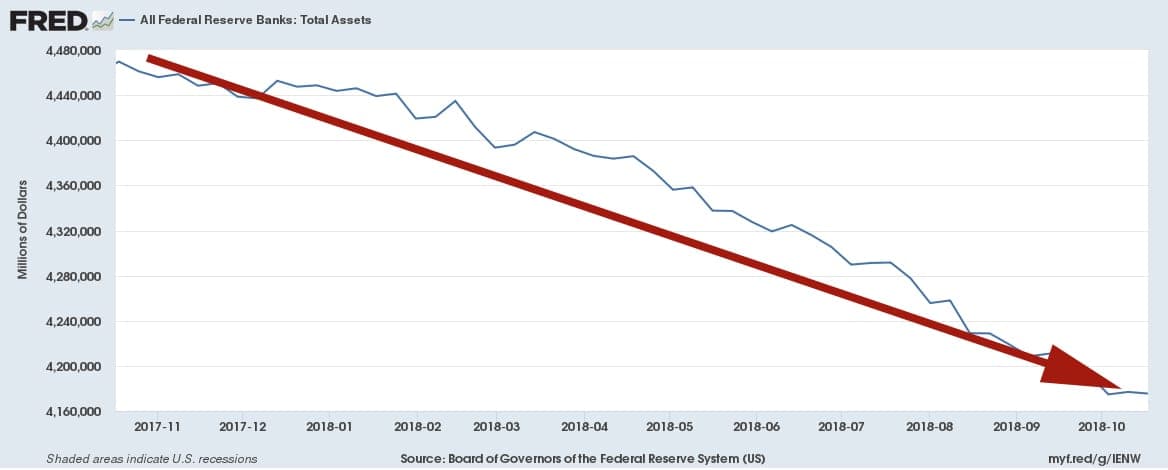
Vor einem Jahr begann die Fed, ihre 4 Billionen US-Dollar an Treasury bonds und mortgage-backed securities abzubauen und monatlich zig Milliarden Dollar zu liquidieren.
Tatsächlich wurden aus den anfänglichen 10 Milliarden Dollar pro Monat im 4. Quartal 2017 bald 20 Milliarden Dollar pro Monat… dann 30 Milliarden… dann 40 Milliarden… und sind nun auf dem Weg, 50 Milliarden Dollar pro Monat zu erreichen.
Werfen Sie einen Blick darauf:
Erinnern Sie sich nun, was ich im März schrieb:
„Da der Bundeshaushalt ab 2019 voraussichtlich 1 Billion US-Dollar überschreiten wird, müssen die USA mehr Treasury securities verkaufen. Viel mehr.
Und das muss sie zu einer Zeit tun, in der die Fed auch die US-Anleihen, die sie in ihrer Bilanz hält, abbaut.“
Und wie hat sich das entwickelt?

„…All diese Schulden, die sich in den Kassen der Regierung ansammeln, werden das Treasury Department dazu zwingen, kreativer zu werden, um herauszufinden, wie sie finanziert werden können.
Infolgedessen erklärte das Ministerium am Mittwoch (1. August 2018), dass es zusätzliche 30 Milliarden Dollar an Anleihen im zweiten Quartal verkaufen muss und eine zweimonatige Anleihe zum Angebot an debt securities hinzufügt. Das ist ein Anstieg um 27 Milliarden Dollar im Vergleich zum ersten Quartal.
In ihrer vierteljährlichen Refinanzierungserklärung teilte das Treasury mit, dass es in den nächsten drei Monaten jeweils 1 Milliarde Dollar pro Monat zu den Auktionen für zwei-, drei- und fünfjährige Anleihen hinzufügen wird.
Darüber hinaus wird es das Auktionsvolumen für die sieben- und 10-jährigen Anleihen und die 30-jährige Anleihe für die August-Verkäufe um 1 Milliarde Dollar erhöhen.“
Mit anderen Worten: Während die Fed ihre Bilanz um 50 Milliarden Dollar pro Monat entlastet, erhöhen die USA stetig die Emission neuer Anleihen, um ihr wachsendes Defizit zu decken.
Und was passiert, wenn so viele Anleihen gleichzeitig auf den Markt kommen?
Diese Raten erhöhen
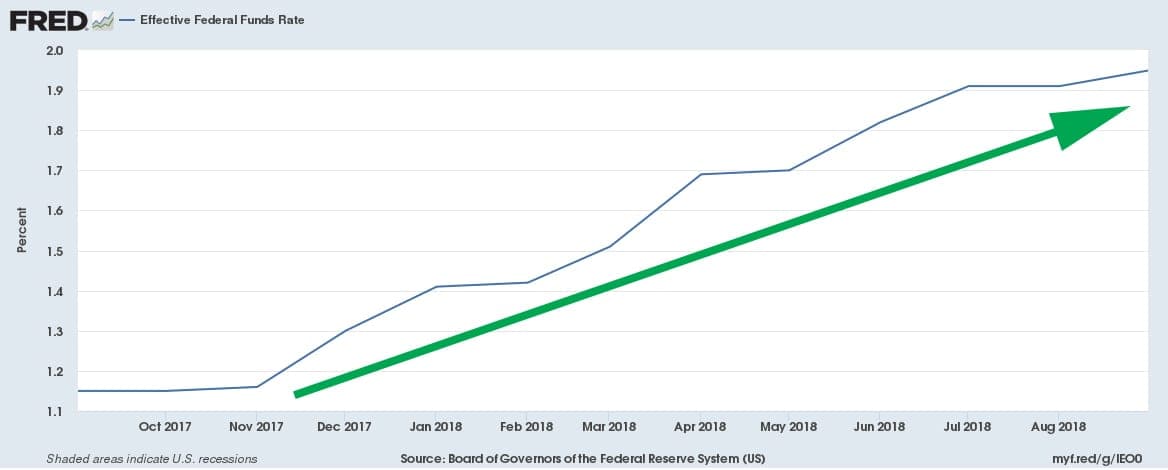
Wenn so viele Anleihen auf den Markt kommen, ist das unvermeidliche Ergebnis ein Anstieg der allgemeinen Zinssätze.
Via meines Briefes vom März, The Ides of March:
„Angesichts des erwarteten Überflusses an US-Anleihen auf dem Markt werden wahrscheinlich bessere Anleihebedingungen erforderlich sein, um um Kapital zu konkurrieren – zumal die Renditen immer noch nahe an Allzeittiefs liegen.
Das bedeutet, dass die Renditen irgendwann steigen müssen.
Im Klartext: Die Zinssätze müssen steigen.“
Hier ist ein Blick auf den Fed Funds Rate, seit die Fed mit dem Abbau begonnen hat:
Und was passiert, wenn die Zinssätze steigen?
Via meines Briefes vom April, How Tariffs Really Affect the Market:
„…wenn die Zinssätze steigen, wird Kapital von den equity markets auf den bond market verlagert.“
Und genau das passiert.
Via CNBC:
„…Investoren haben im August etwas mehr als 19 Milliarden Dollar in bond funds gesteckt, verglichen mit einer Nettoabhebung von 1,4 Milliarden Dollar bei U.S. stock-focused funds, laut Daten dieser Woche (September 2018) von Morningstar.
…Im vergangenen Jahr haben die Zuflüsse in mutual funds und exchange-traded funds zusammen eine unterschiedliche Geschichte erzählt – 293,2 Milliarden Dollar sind in bonds geflossen, während nur 4,5 Milliarden Dollar in U.S. equities gelangten.“
Mit anderen Worten: Der Schuldentransfer der Fed an die Bevölkerung funktioniert.
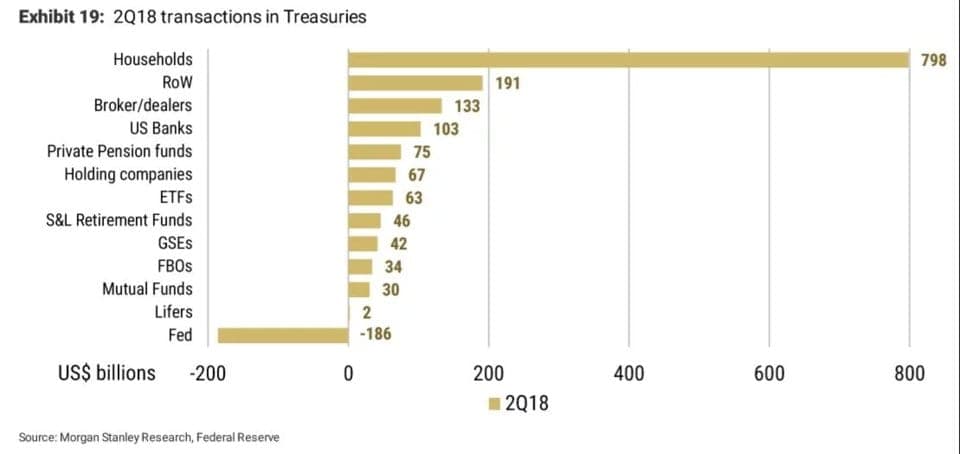
Tatsächlich sind US Households jetzt die größten Käufer von Treasuries – mit großem Abstand.
Via B usiness Insider:
„Treasury demand von US households übertraf die der nächsthöheren Kategorie, RoW (rest of world), bei weitem.
‚Households blieben im zweiten Quartal in Folge der größte Käufer von Treasuries, und sie haben in diesem Jahr bisher 46% des net Treasury supply gekauft‘, sagte MS.“
Deshalb schlug ich im Juli vor:
„Es wäre keine schlechte Idee, sich ETFs anzusehen, die von einem Anstieg der bond yields profitieren.
Da bond prices fallen, wenn yield rises, werden ETFs, die „short“ bond prices, profitieren, wenn dieses Szenario eintritt.
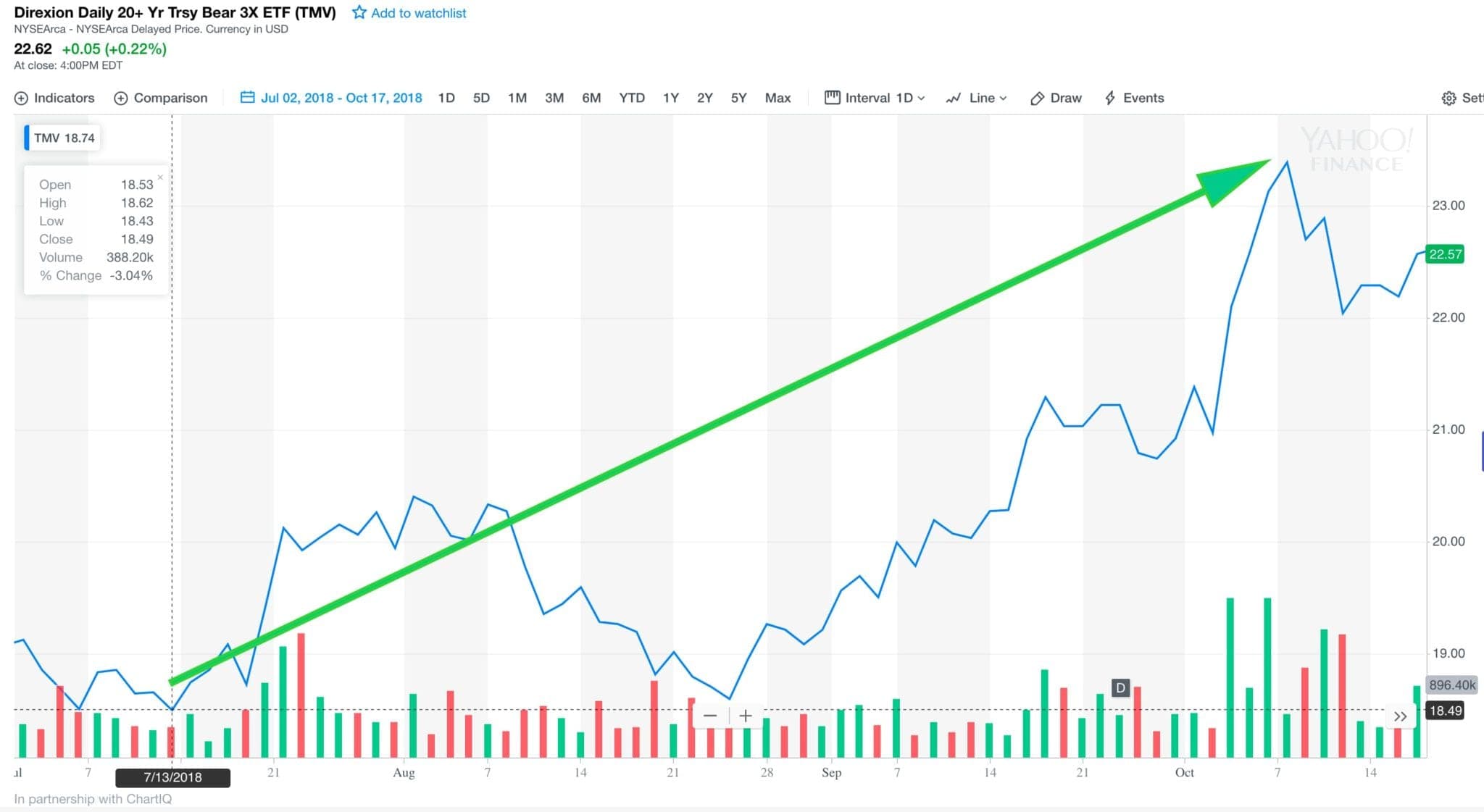
Einige davon sind der Proshares Short 20 Plus Year Treasury (TBF), der no leverage nutzt, der Proshares UltraShort Lehman 20 Plus Year Treasury (TBT), der double leverage nutzt, und der Direxion Daily 20 Plus Year Bear 3 Shares (TMV), der triple leverage nutzt.“
So hat sich der TBF entwickelt:
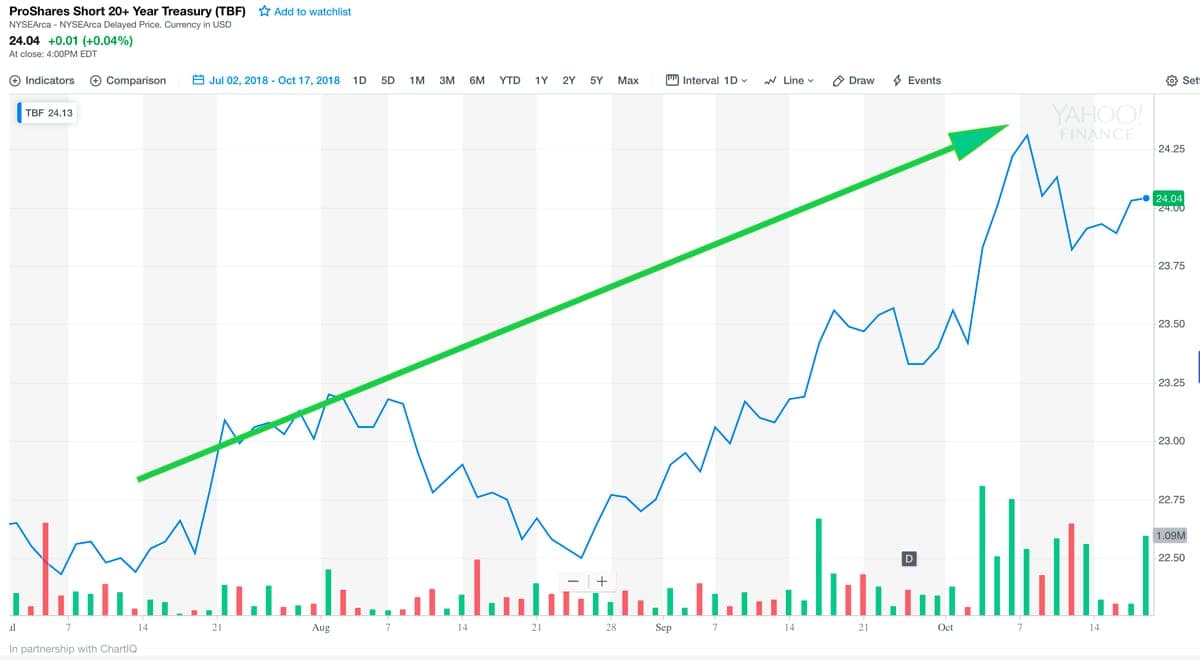
Und wenn Sie das zusätzliche Risiko durch den triple-leverage TMV eingegangen wären, wären Sie in weniger als drei Monaten um über 22% gestiegen und bis zu fast 28%, wenn Sie am oberen Ende des Charts ausgezahlt hätten:
Ich vermute, dass wir weiterhin weitere US equities outflows und mehr bond inflows sehen werden, um den Exodus von bonds aus der Bilanz der Fed zu unterstützen.
Mit anderen Worten: Die reichste und mächtigste Institution der Welt, die Federal Reserve, befindet sich jetzt im Deleveraging-Modus – das ist, wo wir uns im Marktzyklus befinden.
Die Frage für den Markt ist nun, wie weit und wie schnell die Fed beim Abbau ihrer Bilanz vorgehen und gleichzeitig die rates erhöhen wird, um diesen unwind zu ermöglichen.
Der Dominoeffekt
In den letzten Jahren gab es ein gemeinsames Thema, das ich bezüglich unserer Position im Marktzyklus dargestellt habe.
Das heißt, die Geschichte wiederholt sich nicht, aber sie reimt sich (ja, es ist ein berühmtes Zitat, das oft Mark Twain zugeschrieben wird).
Zum Beispiel schrieb ich im Januar:
„Wenn wir darüber nachdenken, wie overvalued der Markt ist oder wie frothy der Markt geworden ist, bedenken wir selten, was das wirklich bedeutet.
Sicher, im Vergleich zu historical data ist der Markt höher und steigt schneller als je zuvor.
Aber nach today’s standards steigt er wirklich so schnell?
Sind stocks wirklich so overbought?
Je mehr gum wir chew, desto bigger the bubble…
Je mehr money wir create, desto bigger the market.”
Mit anderen Worten, kein market cycle war jemals derselbe – die speed at which it rises, how much it rises, how long it goes for – it’s always different.
Der Markt zeigt weiterhin signs of strength durch strong economic numbers und low unemployment, aber investing in today’s market certainly poses a much higher risk than it did five years ago.
Und während die banks today aren’t nearly as leveraged as they were in 2007 und wir don’t (yet) have a potential mortgage crisis like that of 2008, what we do have is a lot of debt – especially corporate debt.
Corporate Debt

Vor mehr als vier Jahren habe ich Ihnen erklärt, wie die Fed den stock market beeinflusst:
„Since Fed policy dictates that it cannot directly buy stocks, the Fed has found other ways to encourage people to take risks.
…One of these strategies is to force banks to lend.
The problem, however, is that it’s difficult for banks to lend to unqualified borrowers. And since the majority of Americans have been terribly affected by the economic crisis, many of them don’t meet the requirements for borrowing.
With so much stimulus, where has all the money gone?
To the people who meet the requirements: big corporations with cash.
Remember a while back when I talked about the record amount of cash hoarding by big corporations and how they weren’t using it for capital investments (hiring, infrastructure, etc.) because the economy didn’t warrant such actions?
So what do you do when you have so much cash, but nowhere to deploy it?
Invest in the stock market…simple!
Since spending didn’t make sense for these corporations, as the economy truly didn’t warrant further hiring or sales, these companies decided to buy a record amount of their own stock with their cash pile.
When a company issues a share buyback, the amount of outstanding shares in a company decreases. This leads to a higher Earnings Per Share (EPS), which makes the stock look much more attractive. This, of course, leads to higher share prices.
…Share buybacks continue at record pace, and I expect billions of dollars in transactions over the next few months alone.”
Und diese Annahme war goldrichtig.
Today, US corporate debt has reached a record US$6.3 trillion.
As a result of cheap money und corporate share buybacks, corporations are now more leveraged than ever.
The good news is that U.S. companies have a record $2.1 trillion in cash to service that debt.
The bad news is most of that cash belongs to a few of the biggest companies.
Via CNBC:
„… the riskiest borrowers are more leveraged than they were even during the financial crisis, according to S&P’s analysis, which looked at 2017 year-end balance sheets for non-financial corporations.
On first glance, total debt has risen roughly $2.7 trillion over the past five years, with cash as a percentage of debt hovering around 33 percent for U.S. companies, flat compared to 2016.
But removing the top 25 cash holders from the equation paints a grimmer picture.
Speculative-grade borrowers, for example, reached a new record-low cash-to-debt ratio of just 12 percent in 2017, below the 14 percent reported in 2008 during the crisis.
„These borrowers have $8 of debt for every $1 of cash,” wrote Andrew Chang, primary credit analyst at S&P Global. “We note these borrowers, many sponsor-owned, borrowed significant amounts under extremely favourable terms in a benign credit market to finance their buyouts at an ever-increasing purchase multiple without effectively improving their liquidity profiles.
The trend persists even among highly rated borrowers: More than 450 investment-grade companies not among the top 1 percent of cash-rich issuers have cash-to-debt ratios more similar to those of speculative issuers, hovering around 21 percent.”
With interest rates rising, there’s a chance many US companies will struggle to service the massive amount of debt they accumulated in the past decade. If that happens, they will have to cut costs which generally means laying off workers.

It’s hard to say what will cause this giant credit bubble to finally pop. We are now 9.6 years into the current bull market and more than 9 years into an economic recovery, of which the longest US economic recovery has been 10 years.
When you consider that most financial crises happen every 10 years, that certainly is a cause for concern.
But going back to the theme of history doesn’t repeat itself, but it rhymes, means we shouldn’t take all of this at face value.
Remember, records are made to be broken.
And while we’re nearing the 10th year of a recovery, it’s also been the slowest US recovery we have ever had. Sometimes, slow and steady wins the race. Could a slower recovery lead to a longer one? Maybe…
If we witness a drop in the stock market of 10 – even 20 – percent, should we be worried? What if after that drop, we immediately see a 50% rise?
In other words, it’s time to be cautious, but not downright frightful.
I have been hearing that the market is overvalued from very smart people for a very long time.
Yet, I keep telling them that they’re going to miss out on a lot of profits by staying out of the market.
And I have been right up to this point.
Ironically, those “smart people” who told me the market is overvalued continued to invest the whole time they were telling me the market was overvalued.
Man stelle sich vor.
There are now more blacks than reds on the roulette wheel. That doesn’t mean the ball can’t continue to land on red.
Gehen Sie voran, aber mit Vorsicht.
Auf Grün landen

What about those green pockets on the roulette wheel?
In every market, there are always outliers that provide incredible money-making opportunities for investors.
And in this market, those green pockets – coincidentally – represent marijuana stocks.
I don’t have to tell you just how much money has been made in marijuana stocks over the last three years.
In fact, you’ve probably traded tons of them for great profits – including one of our earlier ideas this year whose share price more than doubled in just a month’s time.
But now that legalization has officially happened, most marijuana stocks have declined – with the largest marijuana ETF (HMMJ) falling nearly 8% in just a few days.
This has led to the question: is the marijuana run over?
Verpassen Sie nicht unseren nächsten Bericht!
...erhalten Sie ein kostenloses monatliches Abonnementfür einen der erfolgreichsten Investment-Newsletter: den Equedia Letter
*Keine Sorge. Wir werden Sie niemals mit Spam belästigen, und unser Abonnement kommt nur einmal im Monat. Sie können sich jederzeit mit einem einfachen Klick abmelden.
ABONNIEREN
Der Marihuana-Zyklus
Every business has a cycle, and it’s generally assumed they are as follows: expansion, peak, contraction, and trough.
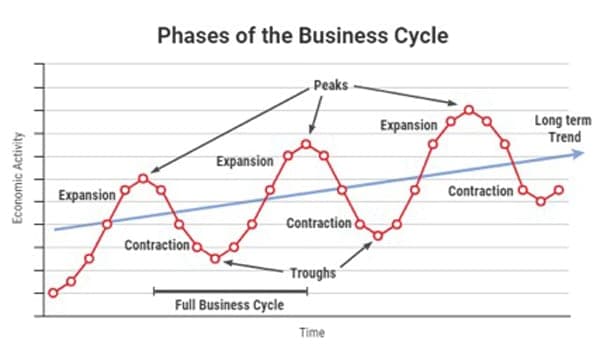
The question is whether or not the marijuana cycle has reached its current peak. Given the profit-taking that has occurred in the last few days alone, one could easily argue that it has.
But because there are so many variables when it comes to marijuana stocks – many of them political – the contraction and troughs could be very short-lived, leading to further expansion and new peaks in the coming months and years.
So while we may see further weakness and volatility, I don’t think the run is over – not even close.
For example, it will take at least a few quarters of earnings for people to gauge just how strong the marijuana market is in Canada.
And even then earnings won’t be an accurate indicator of market potential since the majority of Licensed Producers won’t be growing at full capacity until at least the second half of 2019.
In other words, marijuana stocks will continue to see high valuations because it will take at least a year – maybe more – for supply to catch up with demand.
Furthermore, the regulations for edibles and other marijuana-related products have yet to be resolved, and many of those won’t hit the market for some time.
When they do, it will pave the way for even further growth.
And I haven’t even begun to talk about what could be the most significant announcement of all…
USA legalisieren Marihuana?
!
Die USA werden Marihuana gegenüber immer entgegenkommender.
Earlier this year, US Attorney General Jeff Sessions said he would continue to crack down on marijuana – regardless of individual state laws.
It didn’t take long for Donald Trump to refute those comments by stating that he would likely support a legislative proposal to leave the decision to states about whether to legalize marijuana.
Last month, marijuana stocks sold off as a result of comments by US border officials, stating Canadian marijuana investors and workers could be turned away at the border:
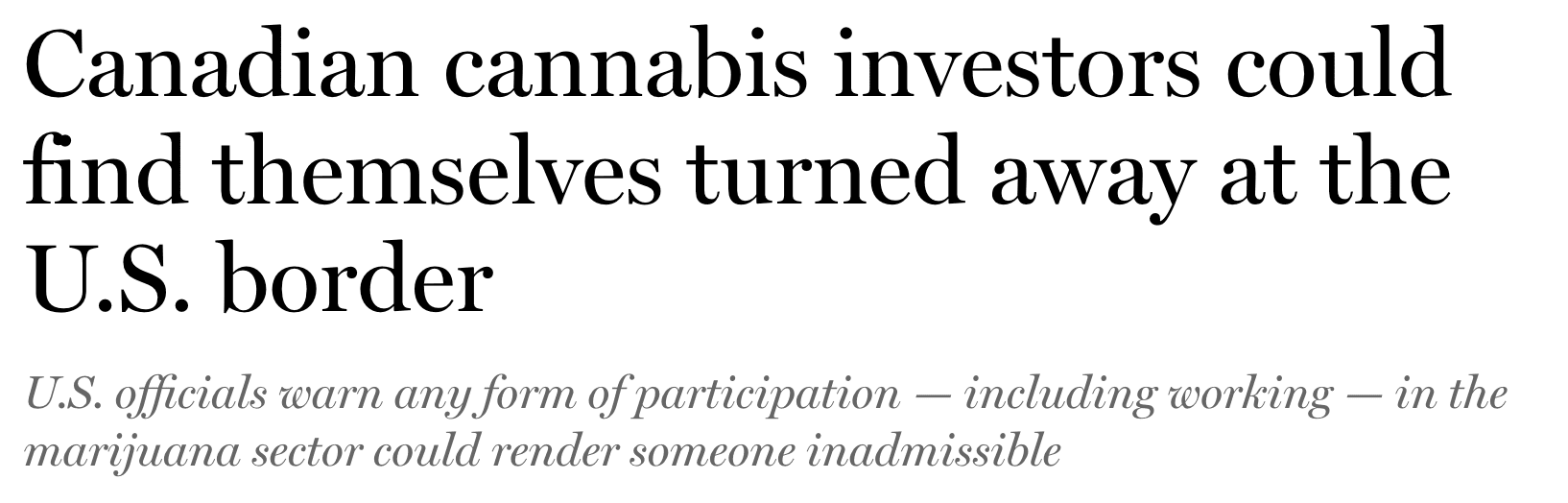
„U.S. officials warn any form of participation – including working – in the marijuana sector could render someone inadmissible.”
Ironically, a few days later, the U.S. Drug Enforcement Administration agency gave a Canadian Marijuana producer approval to export a medical cannabis product south of the border for use in a clinical trial.
It’s no wonder it didn’t take long for US Customs and Border Protection to change their tune.

„U.S. Customs and Border Protection says Canadian citizens working in the cannabis industry should be able to enter the U.S. for reasons unrelated to the marijuana industry.
The agency updated its website Tuesday, providing a measure of clarity after a vague statement last month left the industry and investors facing uncertainty about travel of any kind to the U.S.”
Marijuana is also up for consideration in Michigan, North Dakota, Missouri, and Utah. If passed, the first two initiatives would legalize recreational marijuana, joining nine other states and Washington, D.C.
And you can bet that the passing of any new marijuana laws in the US will fuel the marijuana market even further.
Last, and the most significant spark of all, is the potential for a Federal US announcement on being more marijuana-friendly.
It may not be all-out federal legalization, but if President Trump passes legislation to allow each individual state to handle marijuana, it could be the biggest boon for marijuana stocks ever – much, much bigger than what we have seen in Canada.
And I suspect that could happen sooner than many expect…
Trump will eine zweite Amtszeit

Trump is no idiot – he is the President of the United States, after all.
And you can bet he wants to win.
The US economy is booming, and unemployment numbers are low.
Despite all of the positive US economic indicators under the Trump administration, Trump will continue to be bombarded with negativity amongst the media to sway votes against him.
With the mid-term election just two weeks away, it wouldn’t surprise me if Trump makes an announcement in support of marijuana to sway votes in his favour.
He knows he needs both the House and Senate not only to maintain the power he has had in the past two years but to prevent the potential of impeachment.
Via Straits Times:
„If Republicans maintain control of the Senate, the chances that Trump might be impeached drop sharply – barring any major new scandal – because senators have the final word in these rare efforts to depose a president.
Trump could also continue pushing through his conservative judicial nominees, especially if there is another opening in the powerful Supreme Court, the final legal arbiter on the country’s biggest and most socially sensitive questions.
‚Democrats have lots of opportunities in the House, but not really the Senate,‘ said Kyle Kondik, managing editor of a nonpartisan political newsletter at the University of Virginia Center for Politics.
…If Democrats do take control of the House they will be in a position to launch vigorous inquiries into the Trump administration’s policies and behaviour, and to block Republican-backed laws from passing, including a vote on the federal budget – essentially giving them the leverage to paralyse Washington.”
Trump knows the US midterm elections in the coming weeks are crucial.
So it’s no surprise that his opposition is already using marijuana to sway votes.
Via Forbes:
„A key Democratic congressman has a step-by-step plan to enact the end of federal marijuana prohibition in 2019 if his party takes control of the House…
…’Congress is out of step with the American people and the states on cannabis,‘ Rep. Earl Blumenauer (D-OR) writes in the eight-page document addressed to House Democratic Leadership. ‘We have an opportunity to correct course if Democrats win big in November.
There’s no question: cannabis prohibition will end. Democrats should lead the way.’”
If Trump loses the House after the US midterm, I would bet that he pulls out all the stops in the 2020 US election.
And I believe that could include some form of marijuana legalization – the green pocket on the roulette wheel.
Fazit
As I mentioned earlier, move forward with caution – and that’s precisely what I am doing.
I remain very cash heavy, but not out of the market.
I have taken profits on many marijuana stocks, but I am putting a lot of it back into new ones that better align with the current marijuana cycle.
Those listed, or going to be listed, on a major US exchange likely have the upper hand as they provide much more liquidity and exposure than others – especially if some sort of US law passes on being more marijuana-friendly.
I also suggest looking at retail plays that have deep roots in retail stores and chains, and not just brands.
That’s because these stores are going to be the next big drivers for marijuana. They will be the middlemen – the cash conduits – for the big Licensed Producers
Right now, very few retail chains exist.
But come next month, many of them will open and the rush to buy legal weed will truly be on.
Verpassen Sie nicht unseren nächsten Bericht!
...erhalten Sie ein kostenloses monatliches Abonnementfür einen der erfolgreichsten Investment-Newsletter: den Equedia Letter
*Keine Sorge. Wir werden Sie niemals mit Spam belästigen, und unser Abonnement kommt nur einmal im Monat. Sie können sich jederzeit mit einem einfachen Klick abmelden.
ABONNIEREN
Suchen Sie die Wahrheit,
Ivan Lo
The Equedia Letter
www.equedia.com
Offenlegung:
Wir besitzen Anteile an vielen Marihuana-Aktien und werden von deren Kursanstieg profitieren.
Equedia.com und Equedia Network Corporation sind nicht als Anlageberater, Broker-Dealer oder andere Wertpapierfachleute bei einer Finanz- oder Wertpapieraufsichtsbehörde registriert. Denken Sie daran, dass die Wertentwicklung in der Vergangenheit kein Indikator für zukünftige Ergebnisse ist. Dieser Artikel enthält auch zukunftsgerichtete Aussagen, die Risiken und Unsicherheiten unterliegen, die dazu führen könnten, dass die tatsächlichen Ergebnisse erheblich von den in diesem Artikel gemachten zukunftsgerichteten Aussagen abweichen. Just because many of the companies in our previous Equedia Reports have done well, doesn’t mean they all will. Furthermore, we are biased toward marijuana stocks as we own shares in many of them.